The Elect (Northern Irish Short Stories #3) by Gary Crossey
Welcome to Better World with Design—a personal playground where I explore the things that shape how we see, think, and live. This podcast is my space to review books, music, design, and culture, and to add whatever content moves me in the moment.
But it's also something more: a home for stories I've been carrying for years. Over the coming weeks, I'll be sharing a series of short stories, each one inspired by journal entries I kept during my early years in Northern Ireland. These are fictional narratives—characters, locations, and events have been changed, and the perspective reimagined—but they're rooted in the emotional truth of those recorded moments, transformed into stories that I hope resonate beyond their origins.
In our first story, we stood at a shop window on Sandy Row, watching a bowler hat that became something more—a £15 purchase that turned into a small, stubborn act of wearing history while trying to write a different future. In our second, we stepped into a shoe shop on Royal Avenue, where a rugby player and a shop assistant found brief connection in the careful ritual of fitting shoes.
Today, we turn to a very different community—one that existed in the middle of everything else happening in Belfast. While bombs and checkpoints divided the city along ancient lines, a small group of American Latter-day Saints tried to build their own version of Zion on Irish soil. This is a story about believers and manipulators, about faith communities and the schemes that flourish within them, about two young men performing righteousness while the city burned around them.
This is The Elect by Gary Crossey
Brendan Gorman leaned against the doorframe of the Bangor chapel, watching the February rain streak the windows of the cultural hall. He had the look of a man who understood his position perfectly—which is to say, he had the look of a man performing understanding. His smile came too quickly, his agreements too eager, his testimony too rehearsed. At twenty-six, he had mastered the ecclesiastical theater: the humble nod, the precise pause before speaking, the hand placed reverently over the heart during sacrament hymns.
"Donn Heaney's coming," he said to no one in particular, though Elder Thompson stood nearby, polishing his already polished shoes. "He'll be here by half six. Reliable, that one."
Elder Thompson looked up, offering the blank enthusiasm of the recently arrived missionary. "Brother Heaney seems like a solid member."
"Solid as they come," Gorman agreed, with the casual authority of someone who had been Mormon since baptism at eight, who knew the system's corridors and its unwritten hierarchies. "We served together in branch presidency. Good man. Does what he's told."
The phrasing hung in the air—does what he's told—carrying a weight Elder Thompson didn't catch. But Gorman had chosen the words deliberately. He always did. Every sentence was a calculation, every gesture a bid for position. He had learned early that sincerity mattered less than its appearance, that in the Kingdom of God on earth, advancement came to those who understood the performance.
Tonight's disco was Bishop Wilson's idea—"wholesome recreation for the youth and young single adults," he'd called it at ward council. Gorman had nodded enthusiastically, volunteered immediately to help organize. Not because he cared about wholesome recreation. Not because he enjoyed supervising teenagers doing the twist to "Hey Jude" with the volume carefully controlled to prevent actual excitement. He volunteered because Bishop Wilson noticed volunteers. Because Sister Kearney would be there—new convert, twenty-three, working as a secretary in the city, vulnerable in her fresh enthusiasm—and because she had mentioned, casually, that she was saving for her temple endowment.
Gorman had plans for Sister Kearney's enthusiasm.
Donn Heaney arrived at twenty past six, stepping off the 21 bus with his collar turned against the drizzle. He saw Gorman immediately—you always saw Gorman immediately, somehow—and raised a hand in greeting. Gorman's answering wave was expansive, theatrical.
"Donn! You made it! I was starting to worry."
This was a lie. Gorman never worried about Donn's arrival. Donn always arrived. That was his nature: faithful, punctual, anxious to please. They had known each other since Donn's baptism seven years ago, when Gorman was nineteen and serving in the district council, already learning the levers of Mormon social machinery. He had taken Donn under his wing, had taught him the unwritten rules, had positioned himself as mentor and friend. And Donn, grateful for guidance in this strange American religion that had found its way to Belfast, had never questioned the arrangement.
"Traffic was terrible coming through Hollywood," Donn said, slightly apologetic, though he wasn't late.
"Not to worry, not to worry. Listen, I need your help with something tonight."
"Of course. What do you need?"
Gorman glanced around the car park, then lowered his voice conspiratorially. "Sister Kearney—Siobhan—you know her?"
"The new convert? Sure, I know her. Seems very committed."
"Very committed. That's exactly it." Gorman's voice carried an odd emphasis. "She's planning to go through the temple soon. Next month, she thinks. But there's a problem."
"A problem?"
"Financial. The endowment clothes, the trip to Preston, taking time off work—it's adding up. She mentioned it to me last week, said she might have to postpone." Gorman paused, let the information settle. "I'm thinking of organizing a collection. Nothing official, you understand. Just a few of us who want to help her along."
Donn nodded slowly. It sounded charitable. It sounded like the sort of thing Latter-day Saints did for each other. But something in Gorman's tone made him uneasy—that peculiar eagerness, that edge of self-satisfaction.
"That's generous of you," Donn said carefully.
"Well, we're supposed to bear one another's burdens, aren't we?" Gorman smiled, and the smile was perfect—humble, concerned, exactly calibrated. "I'm going to talk to her tonight, feel out the situation. But I wanted you here as a witness, you know? So it's all proper. Two priesthood holders, nothing that could be misconstrued."
"Right," Donn said, though he wasn't sure why such care was needed for a simple act of charity.
"You'll help me then? Just stand nearby when I talk to her, nod along, show we're united in this?"
"Of course."
"Good man." Gorman clapped him on the shoulder. "I knew I could count on you. Now let's get inside before we're soaked through."
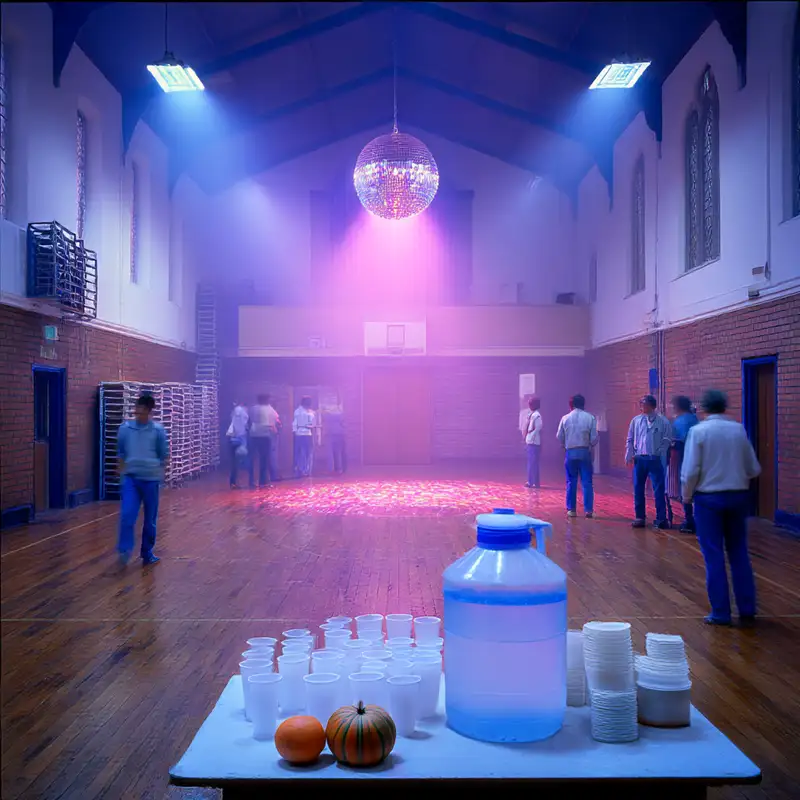
The cultural hall had been transformed with the peculiar optimism of church activities: streamers in blue and gold, a refreshment table with crisps and fizzy drinks in plastic cups, folding chairs pushed against the walls. Brother Davies stood by the record player, sorting through albums with the concentration of a man who knew his selections would be scrutinized. The Beach Boys were acceptable. The Beatles required discretion. The Rolling Stones were right out.
Young people filtered in—teenagers mostly, awkward and hopeful, dressed in their Saturday best which was never quite best enough. A few young single adults, the ones who hadn't married at twenty-one and now existed in the uncomfortable category of "still around." Sister Wilson, the bishop's wife, supervised the refreshment table with cheerful authority. Elder Thompson and Elder Peterson, the missionaries, stood near the door with their identical name tags and interchangeable smiles.
And Sister Siobhan Kearney, newly baptized, stood alone near the stage, watching everything with the careful attention of someone still learning the choreography.
Donn watched Gorman watch her. There was something calculating in it, something that made Donn think of card players studying their hands. Gorman had that look often lately—assessing, measuring, finding angles.
"I'll go talk to her now," Gorman said. "Come with me, but let me lead. Just be there, look supportive."
They crossed the hall. Siobhan looked up, smiled. She had that brightness new converts often had, that absolute certainty that she had found the truth. Donn remembered having it himself once. He wondered when it had dimmed.
"Sister Kearney!" Gorman's voice was warm, brotherly. "How are you this evening?"
"I'm well, Brother Gorman. Hello, Brother Heaney."
Donn nodded, felt suddenly complicit in something he didn't understand.
"I wanted to talk to you about your temple plans," Gorman said, lowering his voice as if discussing sacred matters. "I heard you're hoping to receive your endowment next month?"
"That's right. I've been preparing, doing the temple prep classes." Her face lit up. "I can't wait. It feels like the culmination of everything, you know?"
"It is. It absolutely is." Gorman's tone was reverent, perfect. "The temple is the pinnacle of our faith. Everything points toward it. But I also heard—and forgive me if I'm speaking out of turn—that the financial aspect is proving difficult?"
Siobhan's brightness dimmed slightly. "It's not that I can't manage eventually. It's just that everything comes at once—the clothes, the travel, the time off. I'll need to save a bit longer than I hoped."
"That's what I thought." Gorman glanced at Donn, including him in the moment. "Brother Heaney and I have been discussing it, and we want to help. We're thinking of organizing a small collection among the priesthood holders who know you. Nothing that would embarrass you, just a quiet assistance between brothers and sisters in the gospel."
"Oh, I couldn't—"
"Of course you could. This is what we do. We help each other reach the temple." His hand moved to his heart—that gesture again, perfectly timed. "The Lord provides through his people, Sister Kearney. Let us be instruments in his hands."
Donn watched Siobhan's face, saw the confusion and gratitude warring there. He should say something supportive. That's what Gorman wanted. That's what he was there for. But the words stuck in his throat.
"I don't know what to say," Siobhan managed.
"Say yes. Say you'll allow us to serve you." Gorman smiled, and to anyone watching—to Elder Thompson across the hall, to Sister Wilson at the refreshment table—it would have looked like pure charity. "I'll talk to a few people tonight, very discreetly. We'll see what we can put together. I'm thinking we could have something for you by next week. Would that help?"
"It would help tremendously."
"Then consider it done." Gorman turned to Donn. "Brother Heaney, you'll help me coordinate this?"
Donn heard himself say yes. What else could he say? To refuse would be to deny charity, to fail in brotherly love. But as Gorman moved away, already scanning the room for his next conversation, Donn felt the weight of something wrong settle in his chest.
The disco started. Brother Davies dropped the needle on "I Want to Hold Your Hand," and teenagers began their careful approximation of dancing. Gorman worked the room like a politician, stopping to chat with Bishop Wilson, laughing with the elders, checking on the youth. And at some point, Donn lost track of him entirely.
He found himself standing alone near the refreshment table, holding a plastic cup of orange squash, watching people dance to music that had been popular before any of them were born. The cultural hall lights were bright and unforgiving. The streamers looked cheap. The whole thing felt like a performance of joy rather than joy itself.
Sister Wilson appeared beside him, smiling. "Enjoying yourself, Brother Heaney?"
"Yes, Sister Wilson."
"It's wonderful to see everyone together like this. Such good young people."
"Yes."
She moved on, carrying a plate of biscuits. Donn stood alone again. The minutes stretched. Half seven became eight o'clock. Gorman was nowhere visible. Donn drifted to the edge of the room, then out into the corridor, past the classrooms with their pictures of temples and prophets, past the chapel doors, down to the kitchen where the lights were off and he could stand in semi-darkness.
Through the small window in the kitchen door, he could see into Bishop Wilson's office. The light was on. And there, clearly visible through the window, sat Gorman and Bishop Wilson, deep in conversation. Gorman was leaning forward, earnest, his hands moving expressively. The bishop nodded, reached for something on his desk.
A checkbook.
Donn's stomach turned. He stepped back from the window, pressed his back against the corridor wall. The pieces assembled themselves slowly, reluctantly: Gorman's concern for Siobhan. The offer to organize a collection. The careful inclusion of Donn as witness. And now, Bishop Wilson writing a check—from welfare funds, probably, or perhaps from the bishop's own pocket, moved by Gorman's persuasive charity.
But the collection was supposed to come from priesthood holders. Multiple people. Discreet donations that wouldn't embarrass Sister Kearney. Why was Gorman in the bishop's office alone, soliciting money directly?
Unless the collection had never been real. Unless the plan had always been to extract a single large sum from the bishop, using Siobhan's need as the lever. Unless Gorman intended to pocket some portion himself—or all of it—or to position himself as Siobhan's great benefactor, creating obligation and gratitude that could be exploited later.
Donn thought he might be sick.
He returned to the cultural hall. The disco continued, oblivious. Teenagers danced. Elder Thompson attempted the twist with exaggerated awkwardness. Sister Wilson refilled the crisp bowls. And Siobhan Kearney stood watching, her new-convert brightness undimmed, believing absolutely in the goodness of the people around her.
Donn found a folding chair and sat, watching the room with different eyes. How many others had Gorman manipulated this way? How many small schemes, how many leveraged favors, how many obligations created and exploited? The mentorship he'd offered Donn seven years ago—had that been genuine, or had it been about creating a loyal follower, someone who would nod along and provide cover?
The music changed. The Cure — "Love cats" filled the hall, carefully loud enough to hear but not loud enough to excite. Donn watched Gorman emerge from the corridor, watched him scan the room, locate Siobhan, cross to her with a smile that suggested good news. He bent close, said something that made her face light up. She clasped her hands together, said something that might have been "thank you," and Gorman waved away her gratitude with practiced humility.
Then he looked across the room, caught Donn's eye, and nodded. A victor's nod. A gesture that said we did it.
Donn looked away.
The disco wound down toward ten o'clock. Parents arrived to collect teenagers. Young adults lingered in small groups, extending the evening. Brother Davies packed up the record player. Sister Wilson coordinated the cleanup with the efficiency of long practice. And Gorman found Donn near the door.
"Went well, don't you think?"
"Did it?"
"Very well. Bishop Wilson was incredibly generous. More than I expected, honestly. Sister Kearney will have everything she needs and then some." Gorman's voice carried satisfaction, a barely concealed triumph. "She was so grateful. Nearly cried. It's good to be able to help like that."
"You got money from the bishop directly."
"Well, yes. It seemed simpler than coordinating multiple donations. Why bother five or six people when the bishop can handle it through welfare funds? Same result, less hassle."
"You told her we were organizing a collection from priesthood holders."
"Did I?" Gorman's smile didn't waver. "Must have been a miscommunication. The important thing is she's getting help. That's what matters, isn't it? The outcome?"
Donn said nothing. What could he say? That he suspected fraud? That he thought Gorman was manipulating Sister Kearney's faith for personal gain? Based on what evidence? A conversation glimpsed through a window? His own uneasy feeling?
"You're quiet tonight," Gorman observed. "Everything all right?"
"I'm fine."
"Good. Good." Gorman checked his watch. "We should catch the ten-fifteen bus. Coming?"
They walked to the bus stop through the empty Bangor streets. Saturday night in the town, and somewhere people were drinking in pubs, dancing in clubs, living lives that didn't require constant performance of righteousness. The bus arrived, and they climbed aboard, found seats near the back.
The journey to Belfast took forty minutes. Gorman talked most of the way—about Sister Kearney's gratitude, about Bishop Wilson's generosity, about the importance of helping members reach the temple. His voice carried that same false note of sincerity that had bothered Donn all evening. Every word was a small act of theater, every pause calculated.
"You'll come to the next disco, won't you?" Gorman asked as they approached Belfast.
"Probably."
"Good man. We make a good team, you and I. Always have." He paused, looked out the window at the passing city. "That's important in the church, you know. Having people you can rely on. People who understand how things work."
"And how do things work?"
Gorman turned, studied him with an expression Donn couldn't quite read. "You serve. You show initiative. You make yourself useful to the people who matter. And eventually, you get called to positions of authority yourself. That's how it works. That's how it's always worked."
"I thought we were supposed to serve for service's sake."
"Of course. Obviously." Gorman's smile was thin. "But there's nothing wrong with recognizing that service brings advancement. The two aren't mutually exclusive. The Lord magnifies those who magnify their callings."
The bus reached their stop on High Street. They disembarked into the cold Belfast night. The city stretched around them, indifferent to their small Mormon dramas. Gorman turned to say goodbye, then paused.
"Oh, I nearly forgot." He reached into his jacket pocket, pulled out a small card. A temple recommend—crisp, new, filled out in Bishop Wilson's careful handwriting. "The bishop gave this to me tonight. For Sister Kearney. I'm supposed to present it to her tomorrow at church, after I give her the check. Thought you'd like to see it first, since you were part of making this happen."
He held the card out, let Donn see it clearly in the streetlight. Sister Siobhan Kearney's name, inscribed in black ink. The bishop's signature. The stake president's signature. Official permission to enter the temple, to receive her endowment, to progress along the covenant path.
Purchased—however indirectly, however justifiably—through Gorman's manipulation of her need and the bishop's charity.
"Beautiful, isn't it?" Gorman said softly. "These little cards. They seem so simple, but they mean everything to people like Sister Kearney. Everything." He tucked it back into his pocket, patted it gently. "I'll give it to her tomorrow, along with the check. She'll probably cry again. It's good to be able to affect people like that."
Donn looked at Gorman—really looked at him—and saw clearly what he had been avoiding seeing for years. The eager smile, the false humility, the careful positioning. The weak man playing at strength, the insecure soul demanding recognition, the hollow performance of faith covering the absence of faith itself.
And he saw something else: himself, seven years younger, newly baptized and desperate to belong, accepting Gorman's mentorship without question. Standing beside him tonight, nodding along, providing cover for schemes he didn't fully understand. Complicit through silence, through the desire to be seen as cooperative, as reliable, as one who does what he's told.
"I should go," Donn said.
"Of course. Tomorrow at church then. Big announcement. Sister Kearney's going to the temple, and we helped make it happen." Gorman extended his hand for a handshake—firm, confident, the gesture of a man who believes absolutely in his own righteousness. "Good work tonight, Donn. Really good work."
Donn shook his hand because not shaking it would have required an explanation he couldn't articulate. Then he turned and walked toward his flat, leaving Gorman standing on High Street with that temple recommend in his pocket and that look of satisfaction on his face.
The city continued around him. Late-night buses carried shift workers home. Pubs emptied their crowds onto the pavements. In windows above shops, lights went dark. Belfast settled into the small hours, and somewhere in the settling, Donn Heaney tried to understand what he had witnessed and what he had become.
He thought about Sister Kearney, saving for her temple endowment, trusting in the goodness of the brothers who offered help. He thought about Bishop Wilson, writing a check from welfare funds or personal money, moved by Gorman's persuasive concern. He thought about the temple recommend in Gorman's pocket—that small card that meant everything, that promised exaltation and eternal families, that separated the worthy from the unworthy.
And he thought about Gorman, performing righteousness so skillfully that he had probably convinced himself it was real. The weakest sort of man: the one who mistakes performance for substance, who confuses positioning for principle, who believes that gaming the system is the same as serving God.
Donn reached his flat, climbed the stairs, let himself into the small room that constituted his kingdom. He sat on the edge of his bed without turning on the light, looking at nothing, thinking about temple recommends and schemes and the ways people exploit faith.
Tomorrow he would go to church. Tomorrow Gorman would present Sister Kearney with the check and the recommend. Tomorrow she would cry with gratitude, would testify of the goodness of her brothers in the gospel, would move forward on the covenant path believing absolutely in the purity of the help she'd received.
And tomorrow, Donn would sit in the congregation and say nothing. Because what could he say? That he suspected fraud based on glimpses and instinct? That he feared Gorman had manipulated the situation for personal glory? That the whole thing felt wrong in ways he couldn't quite articulate?
He would say nothing. He would endure. That's what Mormons did—they endured. Endured to the end. The phrase was everywhere in scripture, in lessons, in testimonies. Endure. Persist. Carry on. Never mind if the burden felt wrong. Never mind if the path seemed crooked. Endure.
Donn lay back on his bed, still dressed, staring at the ceiling. Outside, Belfast settled into Sunday morning. In a few hours, he would rise, dress in his Sunday best, take the bus to Bangor again. The pattern would repeat. Gorman would smile and scheme. Donn would watch and say nothing. Sister Kearney would progress toward the temple, believing in the goodness of the elect.
And that temple recommend—that small card in Gorman's pocket—would be presented like a trophy, like proof of righteousness, like evidence that the system worked and God provided and the covenant path led somewhere true.
Donn closed his eyes. Somewhere in the city, Gorman was probably sleeping soundly, satisfied with his good work. And somewhere else, Sister Kearney was probably awake with joy, contemplating her temple endowment, grateful beyond measure for the brothers who had helped her.
Only Donn lay awake in doubt, wondering what it meant that righteousness looked so much like exploitation, that charity could be a scheme, that the elect might be anything but chosen.
The night passed slowly. Dawn would come, and Sunday with it, and another performance of faith in the Bangor chapel. But for now, in the darkness of his small flat, Donn Heaney faced the recognition he had been avoiding for seven years:
He had been following the wrong man toward the wrong destination, and calling it discipleship.
And tomorrow, he would follow him again. Because leaving required more courage than staying. Because exposing the scheme required evidence he didn't have. Because the system was larger than one man's doubts.
The temple recommend sat in Gorman's pocket, waiting to be presented. A symbol of worthiness, extracted through unworthiness. A small card that meant everything, obtained through means that meant nothing.
Donn thought of Joyce's words, from a book he'd read years ago, before his baptism: I will not serve that in which I no longer believe.
But he would serve. Tomorrow and next week and next month. He would serve because that's what he'd learned to do. Because Gorman had taught him well. Because the performance of faith was easier than the confession of doubt.
The night ended. Sunday began. And in the grey Belfast dawn, Donn Heaney rose to prepare for church, carrying his questions like stones, heavy and unspoken and impossible to set down.
The Real Disco
That was the story I wrote—the fiction of Donn Heaney and his disillusionment. But before we end, I want to tell you what was real, because the distance between the story and the truth matters.
The discos happened. The music was extraordinary. And the people—the young adults who created that space—they were genuinely good in ways I hadn't encountered before.
So let me share some closing thoughts about what those Saturday nights in Bangor actually meant to me.
This story is fiction. I made it up. I never knew a Gorman or watched anyone manipulate Sister Kearney's faith for personal gain. The real Mormon church I knew in Northern Ireland was nothing like this.
But I did go to those discos in Bangor. Every other Saturday, the chapel on Hamilton Road would transform—tables pushed back, lights dimmed, Bishop Wilson operating a borrowed sound system with the careful attention of a man defusing a bomb. The playlist was extraordinary.
It was the best soundtrack to teenage awkwardness I could have asked for. These weren't the wholesome, desperate gatherings I've written about. They were actually cool. The young adults who ran them—people in their early twenties, mostly—had impeccable taste. They were kind of punk, actually. They existed in their own scent bubble of righteousness and indie music, and somehow made it work.
They were the smartest people I'd met at that point in my life. They had an acuteness to how they saw the world—a clarity about right and wrong, about purpose and meaning, that I found compelling. They believed things deeply and lived according to those beliefs without apology or self-consciousness. In Belfast in the 1980s, where most people's beliefs led to violence or drinking or both, this was remarkable.
They were good people. Better people than I had known before. They didn't exploit faith or manipulate vulnerability. They just tried to live according to principles they genuinely believed in, and they were kind to an awkward teenager who didn't quite fit anywhere else.
The Mormon church, for me, at that time, in that place, represented something important: it showed me there were different ways to live, different outcomes that could be made. It offered structure when I needed structure, community when I needed community, and a moral framework when the only framework I knew was sectarian hatred.
I eventually left. The church's doctrines stopped making sense to me, and I couldn't pretend they did. But I'm grateful for what it gave me when I needed it—a glimpse of people trying to be genuinely good, a soundtrack of perfect melancholy, and Saturday nights in Bangor where the worst thing that could happen was dancing badly to The Cure.
So before we finish: a few thoughts about why I wrote this story the way I did, and what it's trying to do.
Why this story
I wanted to reckon with performance and sincerity—how people try to live good lives inside systems that sometimes reward the appearance of goodness more than the practice of it. I wanted to honor a community of smart, kind, committed youth who built real culture and trust together, even while carrying the weight of Northern Ireland's background noise. And I wanted to hold tension: the possibility that spiritual structures grant belonging and lift, and the reality that they can be gamed by the ambitious or insecure.
Joyce, by design
This is a deliberate conversation with Joyce's "Two Gallants." The pairing, the errand, the waiting, the small "prize" at the end—reframed as a temple recommend instead of a coin—transpose economic exploitation into spiritual leverage. I used Joyce's method: cool, observational narration and free indirect discourse that keep judgment in the background and let image do the work. The bus there and back, the gray light, the final object in hand—these are Joycean turnings of the screw. And like Joyce's Dublin, Belfast and its satellite towns apply a quiet force. Neutral buildings, careful music, set routines. You feel the geography shaping choices.
How the story came about
The source material came from early journals from Northern Ireland, remembered atmospheres, the actual chapel discos, and the remarkable competence of the youth who ran them. I wanted a fiction that respects the people who created a safe, connected scene, while also asking what happens when a "leader" bends that trust to personal ends. The names and events are reimagined to focus the moral arc. And the music matters—it's not window-dressing. It signals who's really piloting the night, and anchors the story in a credible, local Top 40–meets–indie lineage.
What question this story answers
The central question: What happens to a person's faith when the performance of righteousness begins to feel more real than righteousness itself? And the sub-questions: How do we participate in systems that give us belonging without becoming the system's alibi? What does it cost to name a scheme when you lack proof but not doubt? Where does goodness actually live—in rules, or in people who keep showing up for each other?
The value being set, and how
The value I'm naming is integrity over image. Service over position. Community trust held in common, not privatized by charisma. I set that value by honoring the youth—competent DJs, Seminary mornings, cross-town friendships. The "good" is located in them and their culture-making, not in the polish of a stage-managed leader. I let image do the work instead of rendering verdict: the recommend held like a trophy is enough; we don't need a sermon. And I let the city in—Holywood Ward, Bangor, Belfast, Portadown, Lisburn—place keeps the story honest and the stakes legible.
Where the story leaves us
Donn doesn't resolve the system; the system reveals Donn. That's the point. Recognition precedes action. Sometimes the first step isn't departure or denunciation—it's seeing clearly, and refusing to mistake the mask for the face. And yet: the soundtrack, the friendships, the kindness—those remain the counterargument. They're proof that communities can be better than their worst incentives.
That's why I wrote this one: to hold faith and doubt in the same light, to lift the kids to where they belonged all along, and to set a quiet standard—choose substance, keep showing up, and let the work speak.
Next is my short series based in Belfast is: Too Late for Work
In Too Late To Work, we follow Mr. James Duffy through a single February morning in Belfast, when snow transforms the city and a spontaneous choice threatens to unravel years of careful discipline. Too Late for Work examines what happens when moral rigidity meets genuine desire—and discovers that righteousness and loneliness might be closer neighbors than we'd like to admit.
Sometimes the small rebellions define us more than the grand commitments. Sometimes being too late for work is actually being right on time for something else entirely.
Subscribe today to get notices of New episodes published every Sunday.