The Living Room Violence: A Belfast Story of Domestic Violence and Survival (part 6 of 15)
Welcome back to Better World with Design. I'm Gary Crossey, and I'm genuinely overwhelmed by the response to this series of Northern Irish short stories.
When I started sharing these stories—drawn from journal entries I kept during my early years in Belfast—I wasn't sure how they would land. These are deeply personal narratives, transformed into fiction but rooted in the emotional truth of those recorded moments. And the response has been extraordinary.
Listeners from around the world have been reaching out, sharing how these Belfast moments are connecting with their own experiences of family violence, of living in divided communities, of navigating impossible situations where there are no easy answers. Someone in Australia wrote to say the living room with brown curtains reminded them of their own childhood. A listener in Canada shared their story of growing up in a household where silence was the only survival strategy.
What's striking me most is how these very specific Belfast experiences—the Troubles-era context, the particular pressures of that time and place—are resonating as universal stories about human struggle, about the weight of family dysfunction, about the ways we survive and the scars we carry forward.
This story, "The Living Room Violence," is perhaps the most difficult one I've shared so far. It's about a Saturday night, eggs thrown in anger, and the moment a child realizes that what they've normalized as "just how things are" is actually the thing they'll spend years trying to unlearn.
Thank you for listening. Thank you for sharing your own stories. Thank you for being part of this community that's forming around these quiet, difficult, necessary narratives.
Now, let's begin.
The heavy brown curtains hung like theatre drapes across the living room windows, thick fabric meant to keep out the Belfast cold but serving instead to seal in the sounds that should never have found residence in any home. They were a peculiar shade of brown—not the warm brown of earth or wood, but something manufactured, something that suggested the seventies had arrived and departed with no one noticing the curtains remained, witnesses to everything, holding their silence with the authority of fabric that has absorbed too much.
I went to bed early that Saturday night, seeking escape in sleep before the inevitable arrived. The house had a particular quality of waiting about it—the atmospheric pressure that builds before a storm, except this storm was predictable, scheduled, as reliable as any bus route through town. Dad had been drinking. The time we’d gotten home from Lurgan, where I’d been working for him, established that much fact. Work had been fine, not too busy, but the drinking had made things a little hard.
After someone started saying to him he was drinking, he told me he had not. As if I didn’t already know. It was obvious in every gesture, every slightly too-loud word, and every careful navigation of doorways and furniture. Mum tried not to say anything. That didn’t last long.
They got into it when we got home. I went out and left them at it, seeking the missionaries’ company, seeing their new house, which was a lot better than the last one. The Lurgan missionaries weren’t there, which I was glad about. We just talked and joked about, those missionaries and I, pretending that outside their door there wasn’t an entire world of complications waiting to reassert itself. Then I went home to discover I had locked myself out.
My parents had gone to see Paula, who’d had a baby girl the other day. So I went to see Shelley, then Kirsty, moving through the evening like a piece on a board game, landing on squares that weren’t home, killing time until home became accessible again. When I got back, Mum was there. She said she’d left Dad here as she went to see Paula. Meaning he was away to the pub to get more drink.
The inevitability of it pressed down like the heavy curtains themselves, smothering any hope that tonight might be different. I went to bed early, wanting to get up early, wanting to get ready for church the next morning—as if the promise of Sunday could somehow sanctify the violence of Saturday night.
I don’t know what time my dad got back, but I woke up anyway.
It started with sound first—always with sound first. The key in the lock, the stumbling entry, the particular heaviness of footsteps that belonged to drink rather than merely two feet. Then voices, low at first, Mum’s attempting reason, Dad’s attempting to navigate whatever terrain existed between the pub and the sofa.
Wendy phoned at 1:45. Mum told her to phone back tomorrow. I could have killed him. For I couldn’t get back to sleep. The phone call had pulled me fully into wakefulness, and with wakefulness came the acute awareness of what was unfolding downstairs. The living room was directly below my bedroom, and sound traveled through the floorboards with perfect clarity—every word, every movement, every escalation preserved and delivered to my unwilling ears.
They kept up the shouting for ages. Not the content of the shouting—that hardly mattered, had never mattered. The specific grievances were interchangeable, rotating through a familiar catalogue of accusations and defenses, of ancient wounds reopened and new ones created in the moment. What mattered was the sound itself, the rising volume, the way voices became weapons, became fists made of air and fury.
I lay in my bed in that space between sleep and waking, between childhood and whatever came after, thinking about the events that had happened in that living room with the heavy brown curtains. The sound of violence. The acts of violence that surrounded me in my childhood. The injuries I saw happen. The unhappiness, melancholy, and grief that filled my silent memory.
These were the aspects I had never truly faced, never dealt with. I had made humor of it in my tales of the past, recalled events as if they were merely stories to be told, but I failed to acknowledge that much of my past was still my present. I hadn’t closed that book. I hadn’t allowed myself to begin fresh.
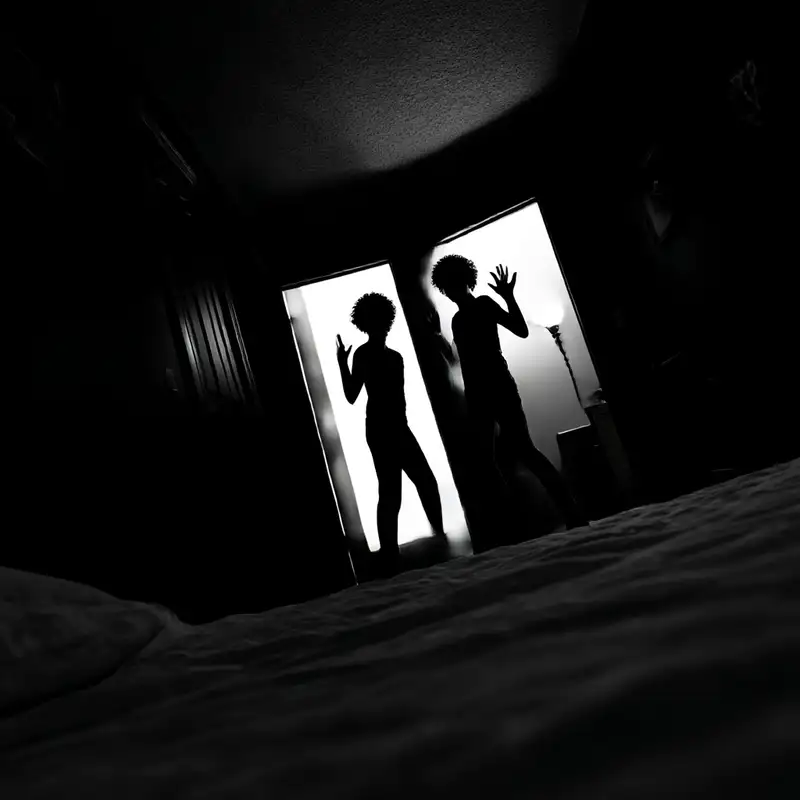
Then, they both came into my room.
The door opened—no knock, no warning, just the sudden invasion of my space by their war. The landing light spilled in, harsh and exposing, and in that light I saw them: my parents, reduced to combatants, to children themselves playing at destruction.
Mum had egg all over her. Which he’d thrown at her.
The eggs clung to her hair, her face, her clothing—viscous and obscene, the bright yellow yolks mixed with clear whites creating a grotesque painting across her person. The shells broke her body, some parts still stuck to the mess, while others were on my floor. Raw egg’s smell filled the space.
They were like children, which makes me so mad.
That was the worst of it, worse even than the violence itself—the childishness. The reduction of two adults, two people who had brought life into the world, who had taken on the responsibility of parenthood, into these petulant, destructive, small creatures who threw things and shouted and brought their war into their child’s bedroom at ungodly hours because they couldn’t contain it anywhere else.
I wonder if those times mark their minds as they do mine? Soup thrown over dad, falling down the stairs for mum. The litany of violence, the catalogue of cruelty. Each incident distinct yet somehow blending into one continuous experience, one long night that stretched across years.
I stopped and questioned what my parents think when they stop to consider the example they have set. Hitting each other, the drinking, the unfaithfulness, the lies, the coldness, the unwillingness, nasty words, reaching hands of forceful ways.
In my room, with the eggs dripping onto my floor, with my parents standing in my doorway like actors who had forgotten their lines, I felt the full weight of what Joyce might have called an epiphany—that moment of sudden revelation when the ordinary becomes luminous with meaning. Except this wasn’t beauty I was witnessing. This was the opposite of beauty. This made me believe in my heart that happiness or realness between two people was lips or a fist upon each other’s face.
I refused to be like my parents. So I remained alone, ‘cause I didn’t know any other way or vehicle to love another.
That refusal was being born in this moment, in this room, with these eggs on my floor and these people in my doorway. The determination to break the pattern, even if breaking it meant remaining alone. Even if it meant not knowing how to love because the only love I’d witnessed was this—this violence dressed up as passion, this cruelty masquerading as caring.
The situation of my family. The sphere where I grew up. This was it. This was the truth beneath all the humor, beneath all the stories I would tell later, beneath all the ways I would try to escape or explain or simply survive. In the living room with brown curtains, the phone rang at 1:45 am in the house where parents threw eggs while children stayed awake, unable to go to church, and pretended normalcy remained.
My parents started going on at me, asking what’s up. And as always, my dad just kept talking. “Who do you think you are?” and other odd things like, “You make time for church.” As if church were the problem. As if my seeking something outside this house, outside this violence, were the betrayal rather than what they did to each other, what they did to me by making me witness it.
I wasn’t in any mood to put up a fight to express myself. Besides, I never get a word in. What was there to say? What words existed that could match the reality of eggs thrown in anger, of violence as vocabulary, of a family that communicated through cruelty?
The eggs continued their slow journey down Mum’s face, dripping onto the carpet, creating stains that would remain long after this night ended, long after they’d retreated to their separate corners, long after I’d given up on sleep entirely. Those stains would be evidence, silent testimony to what happened here, though no one would ever address it. We would clean them eventually, or try to, but the mark would remain, like all marks remain, like all violence leaves its trace.
Each day, as time brought me away from them even more, and others replaced them, I saw many lives not touched by my parents. And, strangely enough, what I’d always seen as the ‘norm’ they saw only with fearful eyes. Too heavy a cross. Would they hold in such times of heightened emotion?
This was my normal. This living room. These curtains. This violence. And I was only beginning to understand that normal was a relative term, that what I had accepted as simply the way things were was actually the thing I would spend years trying to unlearn, trying to escape, trying not to replicate in my life.
Eventually they left my room, taking their argument elsewhere, leaving me with the eggs and the smell and the knowledge that sleep was impossible now. I lay there in the dark, listening to them continue downstairs, the sounds filtering up through the floorboards—muffled now but still present, still poisoning the air.
Someone would pull the heavy brown curtains in the living room below tight, sealing in the scene, and making private what should never have been happening at all. And I would lay here, above it all yet drowning in it, part of it whether I wanted to be, marked by it in ways I couldn’t yet fully understand but could feel with absolute certainty.
This was the living room of violence. Not dramatic, not cinematic, just squalid and sad and utterly mundane in its regularity. Eggs thrown. Words shouted. A child woken. A family destroying itself in small increments, night after night, behind heavy brown curtains that kept out the cold but let everything else in.
And in the morning, we would all pretend it hadn’t happened. We would clean the eggs. We would avoid each other’s eyes. We would go about our business as if the night before had been a bad dream rather than the reality we all knew it was.
But I would remember. The eggs. The curtains. The sound of violence. The weight of it all. And I would carry it forward — this knowledge, this burden, this determination to be something other than what I had witnessed in that living room on countless nights—and weekday nights too, because the violence knew no schedule—when the eggs flew and sleep became impossible and childhood ended in small, irreversible ways.
Thank you for sticking with me as I recounted this tale.
The eggs were real.
The brown curtains—absolutely real.
Every detail I've shared tonight happened exactly as I've described it. This isn't embellished for drama. This is the truth of what my younger self lived through, recorded in journals I kept because I needed some way to make sense of the chaos, some way to prove to myself that I wasn't imagining it, that it was as bad as it felt.
And I want to say something to that younger version of me, the one lying awake at 1:45 in the morning with eggs on his floor: thank you. Thank you for holding on. Thank you for believing that life could be different. Thank you for getting us out of there, even when you didn't know how, even when the path forward was completely unclear. You saved us both.
But this podcast isn't just about my story. It's about something much bigger.
If you're listening to this right now and you live with someone who drinks too much, someone who takes pills to escape, someone whose personality fills every room and leaves no space for yours—I see you. If you're living with people who rely on lies and gossip to feel valued, who turn every conversation into drama, who make you feel small so they can feel big—I see you too.
You are being overshadowed. And that's not your fault.
Here at Better World with Design, we believe in growth. We believe people can learn to be better—to care more deeply, to contribute more meaningfully to our communities, to build lives of substance rather than noise. We believe in keeping harm, cruelty, and violence out of our homes.
And I want to be absolutely clear about something: no one should have to face violence in any way in their own home.
If you're a parent who brought children into this world—if you made that choice, took on that responsibility—then you have an obligation to get beyond your own issues. Your job is to provide a safe home. Not a home with inside violence. Not a home where children lie awake listening to their parents destroy each other. A safe home.
And if you're experiencing this right now—if tonight sounds familiar, if you're the one lying awake while violence unfolds below or beside or around you—please reach out. Tell someone. Call a helpline. Find a counselor. Talk to a teacher, a friend, a neighbor you trust.
No one deserves violence in their home.
Not then. Not now. Not ever.
The brown curtains couldn't keep out the cold, but they hid everything else. Don't let shame or fear or family loyalty become your brown curtains. Don't hide what needs to be seen. Don't accept as normal what is actually breaking you.
Thank you for listening. Thank you for witnessing this story with me. And if this resonated with you—if you heard your own life in these words—please know that you're not alone, and that change is possible, and that you deserve better.
I'm Gary Crossey, and this has been Better World with Design.