The Fire in the Kitchen: A Story of Family Dysfunction and Survival (7 of 15)
This story is being shared as part of the BWWD podcast and our latest weekly publication, Pumped. It explores the often-hidden struggles of growing up in a home marked by tension, addiction, and the small crises that reveal deeper fractures. It's a deeply personal piece, drawn from memory and the kind of details that stay with you—the smell of burning oil, the sound of voices rising, the desperate need to be anywhere else.
I'm sharing it through BWWD because I believe there's value in speaking honestly about family dysfunction, about the ways we navigate chaos, and about the moments when ordinary domestic life tips into something harder to bear. These experiences can feel isolating when you're living through them, as if your home is the only one where things fall apart over a grill pan left on too long.
But they're not isolated. Many people carry similar stories—different details, same weight. By sharing them through platforms like our podcast and Pumped, we create space for recognition, for the relief of knowing we're not alone in what we've endured. We validate each other's experiences and perhaps make it easier for others to speak their own truths.
If this resonates with you, if you've lived through your own version of fires both literal and metaphorical, know that your story matters too. Sharing doesn't erase the past, but it can help us carry it differently—together rather than alone.
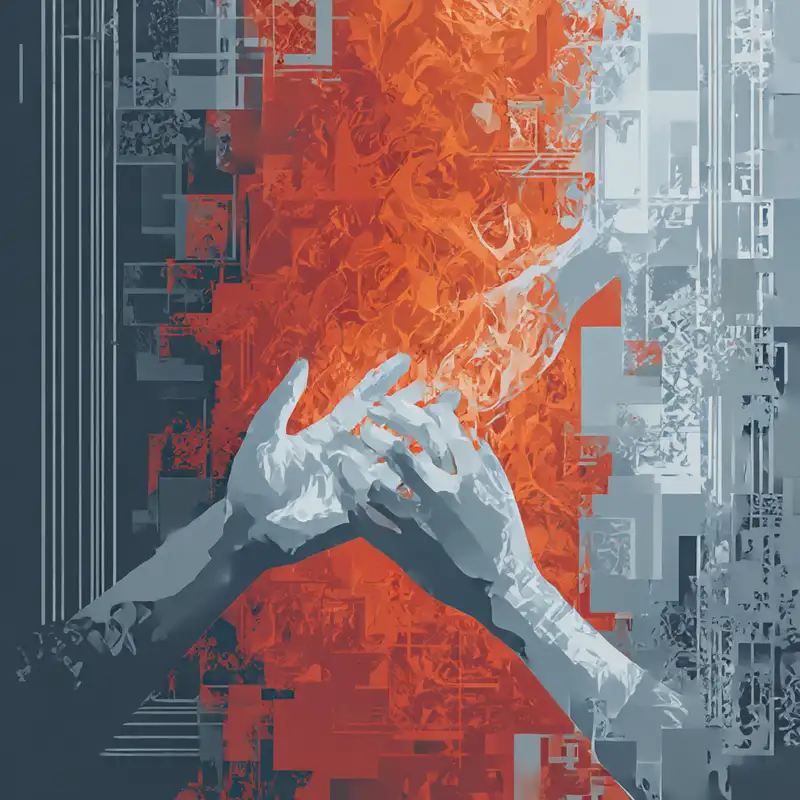
The Fire in the Kitchen
The smell hit me first—not smoke exactly, but something sharper, chemical, the scent of oil pushed past its purpose. I was in my room doing seminary sheets, or trying to, my mind drifting between verses about meat consumption and the persistent question of whether I actually believed any of it. The blue pen I’d found that morning lay on the desk, a minor victory after weeks of black ink bleeding through cheap paper.
I couldn’t get out of bed this morning. That paralysis had become familiar—not depression exactly, though maybe that’s what it was. More like the weight of the house itself pressing down through the ceiling, through the mattress, pinning me there while my mind calculated the cost of getting up versus the cost of staying down. After nearly half an hour, I finally made it to the bathroom, splashed water on my face, and went to school just to get marked present before coming straight back home.
The house was supposed to be my refuge on days like this. Dad is at work, meaning no drinking until evening. Mum pottered about in her own cloud of discontent. The possibility of a few hours where I could exist without having to navigate the minefield of their moods, their accusations, their endless capacity to make everything about their war with each other.
But then came the smell.
I heard Mum in the kitchen, heard the ordinary sounds of meal preparation—the clatter of plates, the scrape of the grill tray being pulled out, the metallic click of the gas igniter. Normal sounds. Safe sounds. The soundtrack of a house pretending to be functional.
The seminary sheets lay abandoned on my desk. I just couldn’t keep my mind on them. Every time I tried to focus on the lesson about dietary laws, about the Word of Wisdom and the spiritual discipline of the body, my thoughts scattered like birds startled by a car backfiring. I felt as if I had gotten nothing out of the study. Then again, you get more out of something if you put something in yourself, and I failed in that part.
The smell intensified. Not gradually—suddenly, like someone had opened a door to something burning. I stood up, moved to my bedroom door, and opened it. Smoke was curling up the stairs, not thick yet but present, visible, real.
“Mum?”
No answer. Just the continued sounds from the kitchen and now something else—a crackling that made my chest tighten.
I took the stairs fast, feet barely touching the treads. The smoke was thicker in the hallway, acrid, making my eyes water. Through the kitchen doorway I could see Mum standing at the cooker, her back to me, and on the grill pan a sight that stopped me in the doorway: flames. Actual flames, bright orange and greedy, licked up from the small amount of oil she’d left in the pan.
She’d left the grill on. That’s all it took. A moment of forgetfulness, a distraction, the ordinary failure of attention that happens in kitchens every day. Except this time the oil had heated past smoking, past shimmering, all the way to ignition.
“Mum! Fire!”
She turned, saw it, and in her face I watched the progression of reactions: surprise, then fear, then something worse—the determination of someone who refuses to be beaten by a domestic crisis. She grabbed the grill pan handle.
“Don’t touch it!”
But she’d already lifted it, flames dancing in her grip like something alive and malicious. She carried it to the back door, pushed it open with her hip, and threw the burning pan out into the garden. It landed in the grass with a thud, flames still leaping, smaller now without the confines of the pan but still burning.
Dad appeared then, materializing as he always did when a crisis offered an opportunity for heroic intervention or righteous anger. He must have come home early, or perhaps the universe simply required his presence for this scene to play out according to pattern.
“What the hell are you doing?” His voice carried that edge I knew too well—the one that said he’d already decided this was her fault, her failure, her evidence of incompetence.
“It’s out now,” Mum said, though we could all see through the back door it wasn’t. The flames had diminished, but the oil still burned in the grass, sending up a thin column of smoke.
“You could have burned the house down.”
“Well, I didn’t, did I?”
I watched them square off across the kitchen, the fire outside a minor concern compared to the one building between them. This was how it always went. Any event, any incident, any moment of the day could become the spark for their particular conflagration.
Dad went out to the garden, stood over the burning pan with his hands on his hips like a general surveying a battlefield. Then he went to the outside tap, turned it on, and dragged the hose over to where the pan lay smoking in the grass.
“Don’t—” I said, but the words caught in my throat. We told her not to do it. We’d learned about this in school, in one of those practical life lessons that Northern Irish education sprinkled between the academic subjects: never put water on an oil fire. Never. The water would sink below the oil, flash to steam, and explode upward, carrying the burning oil with it.
But Dad wasn’t putting water on oil, I told myself. The oil had already burned off, mostly. It was just the pan now, hot metal and residual flame.
He pointed the hose. The water hit the pan.
The fire went wild.
Not an explosion exactly, but a sudden violent expansion—the flames leaping up twice, three times their previous height as the water hit whatever oil remained. Steam billowed up, mixing with smoke, and for a moment I couldn’t see Dad through the cloud. My heart stopped. I saw him dead, burned, his stupidity finally catching up with him in a moment of domestic disaster.
Then, the water continued its work, and the fire went out. The smoke cleared. Dad stood there, hose still running, his face red—from heat or anger or embarrassment I couldn’t tell.
“She was lucky,” he said, as if talking to himself. “She was lucky that the wind was blowing away from her.”
And he was right. When Mum had thrown the pan out, when the fire had flared up, the wind had been blowing the flames away from the house, away from her. Another day, with a different wind direction, and the fire might have burned her. The house might have caught. Everything we owned might have gone up in smoke because of a moment’s inattention and a grill left on too long.
But none of that mattered to them. Within minutes they were fighting again, the fire forgotten except as ammunition for their ongoing war.
“You could have killed us all,” Dad said, coiling up the hose with aggressive precision.
“And you nearly killed yourself with that water. Don’t think I don’t know you've been drinking.”
There it was. The truth that sat at the center of everything, the thing we all knew but rarely said outright. He’d been drinking at work. He denied it when someone said something to him, told me he had not, as if I didn’t already know. As if I couldn’t smell it on him, see it in the slight looseness of his movements, hear it in the way his words came just a fraction too loud, too emphatic.
Mum tried not to say anything at first. That didn’t last long. It never did. They got into it properly once we were back inside, the burned pan abandoned in the garden like a casualty of war.
I went out. Just left them to it. Walked out the front door while their voices rose behind me, accusations and counter-accusations, the familiar litany of failures and disappointments that passed for conversation in our house.
I called to see the missionaries. Their new flat was better than the last one—cleaner, brighter, with windows that didn’t rattle in their frames and a kitchen that didn’t smell of mildew. The Lurgan missionaries weren’t there, which I was glad about. Just the local elders, who talked and joked about nothing in particular, creating the gentle, meaningless conversation that felt like a balm after the intensity at home.
They didn’t ask why I’d come. They probably knew. The missionaries always knew more about the ward members’ home lives than anyone wanted to admit. They saw the signs—the teenagers who showed up at odd hours, the adults who found reasons to volunteer for every activity, the families who only functioned smoothly when they were performing for church.
I stayed until I couldn’t justify staying longer, then trudged home, taking the long route, hoping that enough time had passed for the fight to burn itself out like the oil in the pan.
But when I got home, Mum was gone. She’d left Dad there, she said later, left him to go see Paula, who’d had a baby girl the other day. Meaning he was away to the pub to get more drink. With the predictable pattern reasserting itself, each of them retreated to their preferred methods of escape, here to other people’s happiness, he to the bottom of a glass.
I went to see Michelle and then Kirsty, finding excuses to be anywhere but home. I’d planned ongoing out with Kirsty properly, but when I got to her house, she was away. So I just walked, killing time until enough of the evening had passed that I could reasonably go home and claim tiredness as an excuse to hide in my room.
I got home and found Mum back. I went to bed early, wanting to get up early and get ready for church. Wanting tomorrow to be different somehow, though I had no genuine hope that it would be.
The fire in the kitchen was small. It lasted minutes. The damage was minimal—a burned pan, a patch of scorched grass, some smoke that cleared. But it revealed everything that was always burning beneath the surface of our family life.
I think about that day often, not because of the flames but because of what came after. The way crisis didn't bring us together but pushed us further apart. The way each of us found our own escape—Mum to other people's joy, Dad to the pub, me to the missionaries' flat and friends' houses and anywhere that wasn't home.
We were lucky, Dad said, and he was right. Lucky the wind was blowing the right way. Lucky, the oil had mostly burned off. Lucky, the fire didn't spread. But luck runs out, and patterns don't break themselves. The real fire—the one between my parents, fueled by addiction and resentment and years of accumulated hurt—kept burning. No amount of water could put it out.
I share this story not for sympathy but for recognition. For anyone who's ever stood in a doorway watching their family burn. For anyone who's learned that sometimes the most dangerous fires are the ones that never produce smoke.
If you're listening through BWWD, or reading this in Pumped, I hope it reminds you that you're not alone in navigating the chaos. That getting up when you can't get out of bed is an act of courage. That leaving when you need to leave is survival, not betrayal.
And sometimes, the bravest thing you can do is tell the truth about the fires no one else wants to acknowledge.