Wendy's Troubles (9-15)- Better World with Design
I remember being young and having no answers—not for myself, not for the people I cared about. There was a particular weight to those years, a feeling that everyone expected you to know things you hadn't learned yet, to be certain about things that felt impossibly unclear. Friends would call late at night with questions I couldn't answer, problems I couldn't solve, and all I could offer was the fact that I was listening. Sometimes that felt like enough. Most times, it didn't.
This series of Northern Irish short stories explores those moments when we're caught between who we're supposed to be and who we actually are. They're about the conversations that happen in the dark, the doubts we carry alone, the ways we try to hold each other up when we're barely standing ourselves. These are stories about faith and doubt living in the same room, about the courage it takes to admit "I don't know," and the grace we extend—or fail to extend—to ourselves and others when certainty slips away.
"Wendy's Troubles" is one of those late-night phone call stories. It's about a young man preparing for a mission, about his friend Wendy navigating questions she can't ask out loud, and about the honesty that emerges when the world goes quiet and the facades fall away. It's about learning that sometimes the most faithful thing you can do is tell the truth about your uncertainty—and still show up.
Here's the story.
Wendy's Troubles
The telephone rang at quarter to two. He knew by the hour and the hush it would be Wendy.
“Hello?”
“Were you asleep?”
“It’s grand. What’s wrong?”
“I don’t know. I just needed to talk.”
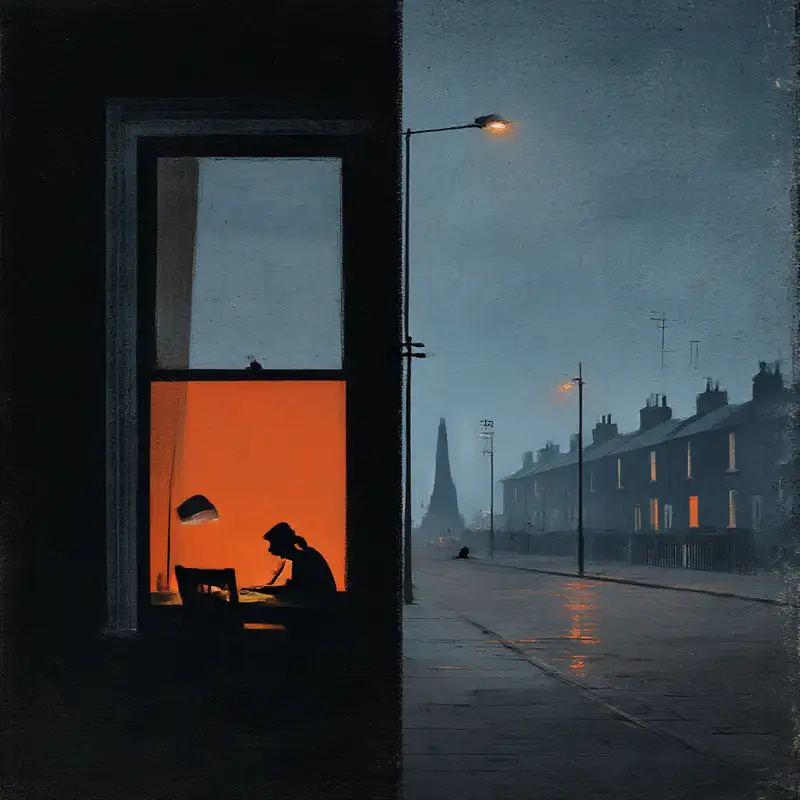
He sat upright. Streetlight cut a pale bar across his desk where his mission papers lay, his name printed cleaner than he felt. It was cold in the room. A tang of damp wool and old polish filled the air. The soft, sporadic click of the thermostat originated within the hall; it never activated the heat, as though the dwelling contemplated warmth before changing its decision.
Wendy said, “It’s my mother again.” “She found the letters from Grace.”
He listened. Tears. Bishop. Apologies offered and withdrawn. The shapes didn’t change, only the volume of the voices did.
“What did you tell her?”
“That Grace is a friend. That it’s nothing.”
“Is it nothing?”
Silence.
“I do not know what it is.”
He had seen her once at a stake activity: careful eyes, standing close as if testing the edge where closeness becomes danger. Later, Wendy mentioned Grace gets things I can’t explain to anyone else. There were other fragments. A small notebook about buses.. Counting breaths when panic climbed her throat. Mix tapes, each titled with verbs such as Breathe, Walk, Stay, structured a day outside religious texts. She, who asked for company, not verdicts. She, whose questions were doorways. It made sense Wendy sounded most similar to herself when she said her name.
The statement, “Your mother desires the greatest outcome for you,” escaped his lips without contemplation.
“She wants me to be something I’m not. Do you ever think like that?”
He looked at the folder. Invite others to come unto Christ. He could recite it. On certain days it touched nothing inside him, similar to tapping a pane of glass and waiting for it to ring. “Occasionally.”
Occasionally, no answer exists.
Conviction seemed like a coat everyone said the weather needed. Occasionally the sleeves fit. On other times, the lining scratched.
“I’ve been reading,” she said. “People who left. Not happy. Honest.”
At the institute that morning, Brother Keenan had drawn paths from doubt to testimony. His own arrows curved and looped behind furniture. “You could talk to the Bishop,” he said, tasting chalk.
She produced a sound like mirth, then stopped. “And say I’m not sure if I believe it? Perhaps I harbor affection for one female?”
He thought of a fast and testimony meeting, of I know hurdling doubt like a stone over water. He had said it too, because I think it drew weathered looks. The chamber where people gave testimonies kept faint, clean smells of polish and carpet shampoo, which concealed something older.
“You could leave,” he tried. “Get a flat. Transfer schools.”
“With what money? You get to leave and be holy somewhere else. I’m here. This is it.”
He saw himself packing doubt into the suitcase with shirts and ties, contraband he would carry regardless. “I’m sorry.”
“You listen. That helps.”
He wished to convey that her true self was the only version that should exist. The sentence snagged on a visiting authority’s talk about the straight and narrow, on his father’s voice—course‑correct, son. The snag held.
They did the soft goodbyes people use when they want to stop needing, not talk. The youth centre rose in his mind: peat smoke and coal ash, damp logs crackling and spitting, a sweet tarry warmth that clung to their jumpers long after they left. Paper cups had sweated in their hands. The cocoa was thin and too sweet. The old radio near the sign‑in desk had hissed between songs as if the building itself were thinking out loud.
He tried to pray in the shape he’d learned. Dear Father in Heaven. Gratitude, then requests dressed as gratitude. Halfway through, he stopped. I am uncertain if I understand. Other folks frighten me when I am unfamiliar with them. I fear change, both in leaving and in not. I want — He could not finish. He let the unfinished want sit between him and God like a chair no one would acknowledge. The pipes ticked again, counting a silence that did not feel empty.
Morning dragged itself across the houses. Milk crates rattled somewhere down the street. A dog barked like a metronome with a cough. He sat through the institute and copied lines. Trials to growth.
He spoke when spoken to. “I’m grateful to learn the truth a little at a time,” and the sentence passed as acceptable.
Then, on the steps, the frost vanished, leaving salt-white particles exposed to the sunlight.
In his workplace, he opened books that had a scent of dust, ink, and the glue of bindings—new paper trying to appear lasting. A returned missionary came in with a laminated smile and told him, missions change you. “Return possessing an iron spine,” the individual mentioned, “plus a heart tender like bread.”
The bell above the door chimed on a spring; it always sounded a little apologetic, as if sorry for interrupting.
That night he traced his name on the manila folder. Worthiness interview complete. Endowment scheduled. He contemplated communication directed toward the Bishop, not contrition, not renunciation, but an itemization: I may utter the words. Sometimes I mean them. Sometimes I don’t. Though doubts may creep in, my commitment remains strong. Listening to the girl at night makes me more human than bearing testimony. I felt something that caused worry. I felt it was not significant. He didn’t write it. The pen he held left a tiny blue dot on the folder where it hesitated.
The phone rang at fifteen minutes until two. Muscle memory lifted his hand.
“My mum says I can’t see Grace. Not even at church. She says I’m confused, and this is what the adversary looks like. I said to Grace that I was confused. That didn’t help. Are you of the opinion that I’m wicked?”
He sat with it. The ready scripture would break on contact. “I reckon you are tired.” And lonely. Working toward goodness in three areas.
“That’s not an answer either.”
“I am uncertain what God desires of you,” he declared, amazing himself. “I’m not always aware of what God desires of me.”
Silence, a breath where relief and sorrow learned to sit in the same room. “Do you sometimes act like you’re faking it?”
He saw his face in the dark window, the outline of a good boy. He remembered the warm water at eight, hands heavy and sure on his head. Sometimes he visited, like an avian creature perched upon a windowsill. Other times, he did not, arranging belongings around the absence.
“Yep. I pretend.”
“Why is that?”
“Pretense can open doors to new possibilities.”
If I voice my ignorance in the wrong place, people will stare at me. Since I want to be the person my mother believes I am. I hoped the words would grow roots. Sometimes they do. Sometimes, they do not.
She laughed, small and real. “I thought you had it all figured out.”
“I do not.”
“What are we going to do?”
He pressed his palm to the desk. The grain under his skin seemed like a map to a country he hadn’t learned to read. Possibly share the truth in small amounts when it’s protected. It is possible to establish security for each person.
“Is that allowed?”
“I’m unsure,” he stated, and the statement seemed like fresh air.
“I’m going to get some sleep.”
“You may call me if needed.”
She paused. “When you leave—”
“I’ll still be me,” he said, hoping it was true. “And you’ll still be you.”
Wendy had told him once Grace sat with me on the church steps through an entire youth activity, counting the buses by their routes until her hands stopped shaking. That locale possessed the scent of diesel mixed with precipitation. Grace had kept her hand flat on the step between them, not touching, as if touch were a match and the evening too dry.
After she hung up, he stood at the window. The sodium lamps buzzed. A fox skittered a bottle into the gutter. The glass against his forehead felt like metal. A late taxi idled a street over, its engine a low animal. Somewhere a gate clanged and then hushed.
He was reading, hoping to find a passage about dwelling rather than focusing on sentence correction. He copied a passage about belief and hope, leaving it behind without my knowledge. At breakfast, his mother said, poor girl and meant it. The tea had a tannic and kind aroma. He buttered it anyway and listened to the kettle shiver. His father entered, frost from the period still crisp upon coat shoulders, uttering nothing, which proved peaceful if observed.
The day took its shape. His prayers were honest, and he flourished with plain words. He formed two registers—Things I Don’t Yet and Things That Still Seem Like Light—and didn’t include Grace’s name in either. He noted, “The warmth of space when uncertainty surfaces.” The scent of peat. Weight pressed upon the cranium when heartfelt. Grace’s verb tapes. The sound of buses arriving is like commas.
As twilight fell, the shop was vacant, the bell hushed, and he cleaned the counter with a lemon-scented cloth. He re-shelved a mis-placed book in Biography. The zip of the jacket was satisfying. Small orders in a larger drift.
Again, the telephone rang nearing two o’clock. He said hello in the familiar dark and listened. He stepped away from the charts. After getting guidance, he examined what made it deteriorate, what made it bearable, where breathing was easier. He replied, “Perhaps show kindness toward your existing self.”
“Is that different?”
“It is different here,” he stated, touching his chest like she might see. He sensed his own heartbeat as a practical thing, not a metaphor.
She depicted her mother’s kitchen: the widespread scent of cabbage, the gluey sugar tin, and the curled lino. He listened until details gathered, forming something akin to existence rather than only inquiry. Grace penned, upon the reverse of a transit fare, “Try tomorrow still strives.” She stated he would record it.
After she hung up, he watched the lamp‑lit the street’s false cleanliness. Morning would show the cracks, and also the small repairs. Somewhere a milk bottle gave its thin neck a clink against another. Bottle and then settled. A cat trotted along the wall, tail held high like a small flag of insistence.
The folder, city, and forgotten language, he contemplated. At a distance, he imagined himself speaking, then considered usefulness with only questions. He was uncertain. He persevered, and the faith he had transformed him as he spoke the truth about uncertainty. It is possible that faith was a coat sometimes. Perhaps on other days, the choice was to go outside despite everything.
His president, ward, or mother might disapprove. God might find it was enough, he suspected. God, too, he suspected, didn’t mind being asked twice.
He closed the curtains and lay down. The unspoken prayer finished itself without him. During the short drift before sleep, he envisioned the youth center fire once more. The small coal collapses, the yielding of a log with breath, and afterward, the vision diminished, resolving into warmth, lacking borders.
The phone would ring again. It always did.
That's the end of "Wendy's Troubles."
You know, there's something profoundly intimate about returning to moments preserved in journal entries from over thirty years ago and giving them breath as stories. The late-night phone calls in this story—those actually happened. The weight of not having answers, the desperate attempts to be useful when you're barely holding yourself together, the peculiar loneliness of being the person others call at two in the morning—those feelings come directly from notes I made in 1990.
What I find most compelling about revisiting these moments is that each one mattered intensely at the time. They were pivot points—moments that could have gone either way, or nowhere at all. The protagonist in this story is caught between the faith he's supposed to embody and the honest uncertainty he actually feels. He's preparing for a mission while secretly wondering if he believes any of it. And yet, in those late-night conversations with Wendy, he discovers something true: that listening without pretending to have answers might be more valuable than bearing testimony with false certainty.
These stories are part of a fifteen-story series drawn from my early years in Northern Ireland—a place where every choice carried weight, where religious identity intersected with sectarian divisions, where young people navigated between who they were supposed to be and who they actually were. Each story stands alone, but together they form a portrait of coming of age in a specific time and place, exploring themes of faith and doubt, friendship and isolation, the cost of honesty and the seduction of performance.
The people in these stories have been transformed, the places reimagined, but my love and respect for everyone who appears in them has remained constant through the decades. Wendy was real. Grace was real. The confusion, the compassion, the desperate phone calls—all of it happened, even if the details have been reshaped in service of narrative truth.
I'm grateful to be bringing these stories into the world now, three decades after the moments that inspired them. Each one is an act of remembrance and transformation—taking what was private and making it resonant, taking what was specific to Belfast in the 1990s and finding the universal threads of doubt, longing, connection, and loss.
Thank you for listening to "Wendy's Troubles." Next time, we'll explore another moment from those years—the fragmentation continues, the journey deepens.
I'm Gary Crossey, and this is Better World with Design.