The Black Hair Dye (11 of 15)
Welcome back to Better World with Design. I'm Gary Crossey, and this is the eleventh of fifteen stories in my Northern Irish short story series.
Eleven stories. We're deep into this journey now, and the connections you're making keep surprising me. Listeners have shared how these Belfast moments mirror their own experiences of growing up caught between expectation and identity. Someone wrote about their own small rebellions. Another about the gap between who we're told to be and who we're becoming.
Tonight's story is about that gap. It's about a seventeen-year-old boy who buys black hair dye—not brown, not dark brown, but pure black—and somehow manages to stain every surface in the bathroom except his actual hair. It's about his mother's fury when she discovers what he's done. About a Halloween evening visiting neighbors. About a blindfolded fortune-telling game with saucers: coin, water, book, and something darker. And about the comedy and tragedy of transformation—how the dramatic change we imagine rarely matches the barely noticeable shift we achieve.
This is a story about being young and Mormon in Belfast, about trying to carve out some small space for self-determination within tight parameters. About the marks we leave when we try to change, and the marks that won't come off no matter how hard we scrub.
The story is called "The Black Hair Dye."
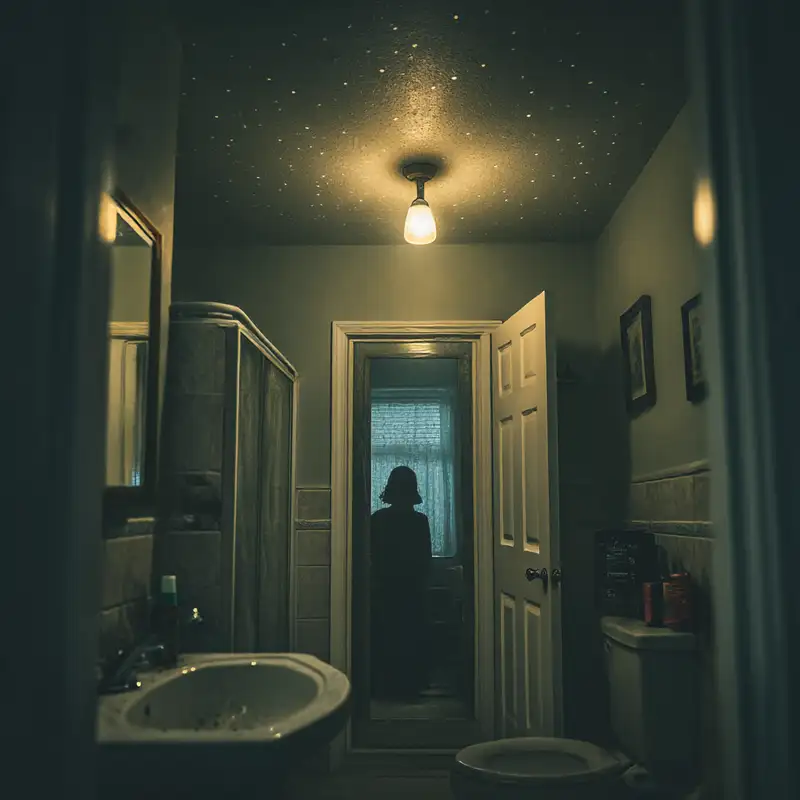
Last night: towel on shoulders, the box on the cistern, black as certain as print. The bottle’s reek rang the room and climbed the hall. He painted it as scripture, watched the clock, rinsed till the water ran thin, then thinner—ink down a white throat. The hair went near‑dark; the house took the mark. Black freckles on tile and porcelain. A ring at the sink, a bruise round the taps. Towels striped. Grout greyed. Wallpaper flecked like soot. On the ceiling, a small constellation. His hands stung; the cloth went slate; the drain ran honest black. At his nail a crescent set like a bad moon no scrubbing would lift.
The kitchen was scrubbed to brightness; you could see yourself in the tap if you bent to it. The sink ran sweet of bleach. Cloths folded edge to edge; the nail‑brush bristles‑up like a small fir. When the tea‑things were cleared and the last cup dried on the heat, his mother said he might step out—back before the Angelus—and he thanked her softly. He turned the cloth once and set it square. “It’ll have to do,” she said, drew a knuckle over a pale stain, felt it, turned away.
He took the Boots wallet—cloudy at the hinge—and counted with his thumb: enough for the bus and something nice besides. Nails clean near enough, only the black in crescents that wouldn’t lift. He rubbed one half‑moon till the skin heated. Change, he thought. Only this. The coat on the hook. A cold square of landing light on the stair.
His father had been out late and come heavy, the coat sour with stout and damp. In the morning he rattled coins flat on the sideboard, as if sound might do for talk. He said nothing, shifted in the armchair to let the newsreaders have their say. The house took its cue.
Outside, streets shone with earlier rain. The Citybus was full; he held the pole, made himself small. A gentleman in a brown hat set a knee for him; he said thank you. The young stared straight on. At University Road, lights went green; Queen’s railings took the lamps in their points; Botanic trees pressed wet leaves onto the flags.
He would bring something sweet and small, the way you do of an evening. Botanic bakery warm, hiss at the urn. The glass case fogged a corner. “Next, love,” said the pale‑lashed girl. “Traybake—the thick one, please.” She tied the string twice, snapped it neat, slid parcel and buns into the bag. He almost said black bun—for the look, the coal—swallowed it, let the moment pass. Outside, the rain was a mist. The Ormeau bus came quick; he found a seat. The brown‑hat said the weather did no good to bones. Soft enough if you let it, he said. The driver braked; the bag swung, the string bit his wrist. “Steady, mate,” someone said, not unkind.
On the window, his reflection rode the wet glass—hair darker, nearly—and behind it the Boots box hovered up, pure black as promised; the bottle hadn’t kept. Botanic signs swam: second‑hand books, a guitar in a window, a boy with a proper black fringe low. He made his coins add up to a life: bus there and back, a sweet, a bit by for tomorrow, the mission tin on the dresser not a penny closer. The half‑moon smiled at him for foolishness.
“It’s him,” a little girl said when he came to the door; the neighbor woman had the lamp up. Mrs Kavanagh—always the neighbor woman in a street. Singing in the back room—simple things. “Give over a minute,” said the big lad, “we’ll make the tea.” A pram in the hall held coats; a damp scarf steamed by the radiator. The dog under the chair blinked as if to say it was his house too.
He passed the bag for dividing and set the other parcel down. When they went to lay the plate, the stringed parcel wasn’t in it. Right pocket, left pocket, the lining where it had come away at the seam. The hall stand top, the sill with cards and the blue pen. The girl shook the bag and shook her head. “Left it on the bus,” said the neighbor woman, not unkind. Heat rose; he smiled the way you do for a mistake at sums. “We’ll have plenty,” she said, pushing the penny buns nearer. “Jam as well. Sit you in.”
The kettle rattled. Windows sweated. The big lad—Seamus—with sleeves rolled, blue biro on his hand for a number not to forget. “Saucers?” he said, and the two girls—Bridget with teeth too big yet and Nuala quieter—went to the dresser. Coin, water, a small book. A fourth saucer set back, almost behind the jug.
“Blindfold,” said Bridget, solemn with the power, and tied the scarf gentle as for a sore head. “Right,” said Seamus, “first go.”
He stood with his toes to the chair‑leg and put his hand out flat. The room listened through the cloth. He drew breath, reached for the coin—quick, a thief’s hand at a saucer—missed, slid right, found the book’s edge. Raised lip, cold nothing of plate, the paper thin and soft. “Book,” said Nuala. A small sound from the neighbour woman, maybe a breath. “Och well,” he said, light, and they laughed the laugh that lets a thing pass.
“Again,” said Bridget, “proper.” The scarf retied, tighter. Two turns for luck. “Hand,” said Seamus. He raised it. The others seemed to draw away. His palm found cloth—cold and wet. When he lifted, the black was on his fingers again. A catch in the room. “Out with that—no call for that at all,” said the neighbor woman, sharp; Nuala to the bin and the basin. “Only a bit of fun,” said Bridget; Mrs Kavanagh’s look ended it. They did it again; they’d have guided him to the coin if he’d let them; he set his palm, slow, on water. “So,” said Mrs Kavanagh, soft now, “you’ll be a great reader yet, and you’ll cross oceans—see if you don’t.”
He smiled, took the towel. The book looked from the plate like a small duty folded up. A fine prophecy; it felt, just then, like a sentence.
They sat him by the fire. Seamus cracked nuts with the heel of his hand, no hunting crackers. Tea from the big brown pot. “Milk already in,” she said. The girls told about the teacher with the sparking wool skirt, the boy who stole chalk, how their da said no pumpkins for the price. “We’ll draw a face on the turnip,” said Bridget, grim as a judge. “It’ll do rightly,” said Seamus. The dog put his chin on the lad’s shoe as if that settled it.
Talk ran to buses—early when you need them, late when you don’t—and to Queen’s: new library doors too heavy for Nuala to love; the boy in the hat who sang under the arch. “There of a Saturday,” said Seamus. “Knows them all—Christy Moore to Cohen and back.” The lad nodded like he had them by heart. “Sing us one,” said Mrs Kavanagh, “only a bit, for the wee ones.”
“I haven’t one in me,” he said, softer than refusal. “You have,” she said, touching the keys to place the note. He stood by the stand‑lamp and took up “The Day Thou Gavest” low and even, just the first lines; when the second should have come he sang the first again. No one minded. A song that asked little. The neighbour woman touched the keys after, like blessing; Bridget’s mouth made the shape to keep it.
“Are you at the mission lads then?” said Seamus—too blunt maybe, not meant hard. “Seminary,” the lad said, and left it. “Up the mornings,” said Mrs Kavanagh, kind enough, “there’s grace in that.” He thought of the blue book on the locker with its gilt still up, the mornings he’d not risen, the part of him that dragged at the bed like an anchor. If there was a script for a life, someone had written his lines in a hand he could read and didn’t want to copy. He turned his thumb over the black half‑moon at his nail.
They talked of work not yet work—joiners for Seamus after Christmas if the foreman meant it; Bridget nurse and singer and teacher “if the money finds us”; Nuala to keep the dog and the dog to keep Nuala. The neighbour woman asked after his mother, meant proper. He said the house was to rights and the kettle never far; no pumpkins at their bit either. “Who needs a face at the window,” said Mrs Kavanagh, “with all the faces in the street?” She laughed, not only a laugh.
They were for the games again. He held the blindfold while Bridget had her turn—coin, bold as brass. “I’ll be minted,” she said. “Buy my coat in the January sales,” said Seamus. Nuala got water and jumped as if it found her cold; they clapped. He kept his hands to the saucers after, as if a hum lived there when the scarf was off, and the cloth—though gone—wasn’t gone from him.
He left early so as not to miss his bus. Mrs Kavanagh put a penny bun in his hand and another in his pocket. “Mind the steps,” she said. “Treacherous for a soul thinking of other things.” The rain had stopped. Queen’s railings laid long neat shadows on wet flags; the wind had died. At the corner a boy with black hair—the proper black—passed with his head down; the shine took the lamp for a step and was gone. He counted coins. Enough.
He let himself in quiet, hung the coat. The landing bulb hummed. In the bathroom, chrome bright enough to comb by; on the ceiling a pin’s head of black took the light like a bead of tar, bright at the rim. In the mirror his hair was only his hair—near‑dark in landing light; daylight would tell the truth again. He lifted a strand; the bottle’s smell came back—truth you couldn’t sweeten. He ran two fingers through; the dye left a dry drag the shampoo hadn’t fooled. He held his hand under the tap; clear water ran over a stain that would not go at the nail.
On the locker the blue book had its gilt still up. He set the penny bun beside it—bread and word—and turned the book once, set it straight. Downstairs, his father coughed, folded the paper to a long neat strip and tapped the chair arm—coins without coins—then rattled the pages as if they held money he could shake free. The kettle began again without being asked; his mother’s way was to keep it ready and let mercy do the rest. Upstairs, two coppers dropped to the mission tin and made a brave noise for a small thing.
He told her the children sang and the buns were good, that Nuala would save the dog from thunder. She lifted the cloth, turned it once more in her hands, said nothing. He thought to say he was sorry for the stain and the morning and the dye that had carried itself like a boy who wouldn’t be told; instead set the bun on the plate and broke it so steam rose, and she pushed the butter to him, the way you do when there’s more to say than will do any good.
After, he went up and sat a minute in the quiet. The blindfold made a black band on the inside of his sight and then it didn’t. He felt the saucer lip, the slip of paper, the cold wet, the book’s weight in a future hand. Outside, Belfast kept on its night, lamps making small promises along the road; in the street below a voice started a line and another answered, the line old and the answer knowing its place. He rubbed at the half‑moon on his nail again and left it be.
My Notes On Writing This Story
This is where the story ends. Not with a twist, not with a revelation that changes everything you thought you knew, but simply with an ending—the kind that feels more like life than literature.
I need to be honest about what I was trying to do here, and why I'm not entirely certain I succeeded.
What I Was Attempting
This story was meant to capture something specific: the weight of performing faith, the exhaustion of maintaining appearances, and the quiet disappointment that settles in when you realize that the promised community might not materialize in the way you'd hoped. I wanted to explore how young people navigate spaces that ask them to be both authentically themselves and carefully curated versions of themselves simultaneously.
More than that, I wanted to examine the particular loneliness of being seen but not known—of being surrounded by people who would call you "brother" or "sister" but who might not actually know what troubles you, what makes you laugh, what keeps you awake at night.
The disco setting was deliberate. It represents the church's attempt to create "wholesome" alternatives to the world outside, but in doing so, it often creates spaces that feel artificial, performative. The characters attend because it's expected, because it's "what you do," because not attending would raise questions. But the gap between what they're supposed to feel and what they actually feel grows wider with each event.
Where I Struggled
I don't feel like I got the characters where they needed to go. Mark and Ciarán remain somewhat at a distance—observed rather than fully inhabited. I can describe their actions, their surface thoughts, but I'm not sure I've captured the deeper currents of disappointment, resignation, or hope that would make them truly breathe on the page.
Part of the difficulty was tonal. This story exists in a gray space—not quite satirical enough to be cutting, not quite sincere enough to be heartbreaking. It's observational, perhaps to a fault. I wanted to trust the reader to see what wasn't being said, to feel the weight of all those silences and small gestures. But I worry that in trying to be subtle, I may have been merely vague.
The dialogue gave me trouble too. These are young people trying to sound more mature than they feel, trying to perform the language of testimony and conviction while wrestling with very ordinary doubts and desires. Finding that voice—earnest but not naive, critical but not cynical—proved harder than I anticipated.
The Temptation of the Twist
Here's what I keep wrestling with as I work through this series: the closer I get to the end, the more I feel the pull toward dramatic revelation. A twist. A surprise. Something that would make the reader gasp and reconsider everything that came before.
It would be easy to end this story with a revelation—that Mark and Ciarán had been planning something all along, that one of them was about to leave the church, that something significant was about to happen. The architecture of the story could support it. I've planted enough ambiguity, enough unspoken tension.
But that would be a betrayal of what these stories are meant to be.
This is not a thriller. It's not building toward a moment when everything clicks into place and makes sense in a new way. It's a series of small stories about ordinary struggles—about trying to be good, trying to belong, trying to reconcile what you've been taught with what you're experiencing. Real life rarely offers those narrative satisfactions. Real disappointment doesn't come with a revelation; it accumulates slowly, imperceptibly, until one day you realize you're going through motions that no longer mean what they once did.
Each story in this series has tested my resolve to resist that impulse. Each one has had moments where I could insert drama, conflict, revelation. And each time, I've tried to pull back, to trust that the smaller, quieter truth is more honest and ultimately more powerful.
Voice and Comparison
This story's voice is more detached than some of the others in the series. Where other stories might have dwelled more in a character's internal landscape, this one maintains more distance. It watches. It observes. It notes the small details—the coordinated outfit colors, the carefully chosen music, the way people smile when they're supposed to rather than when they want to.
If "The Bowler Hat" was about small victories and the meaning we assign to objects, and "Working the Floor" explored the weight of early responsibility, this story is about the particular kind of fatigue that comes from performing belonging. It's less about what happens than about what doesn't happen, what can't be said, what remains unresolved.
In the context of the series, it's perhaps the most melancholy. Not tragic—there's no tragedy here, just the slow recognition that things might not be what you'd hoped. That realization isn't dramatic. It doesn't announce itself. It simply settles in, like the feeling of the bus ride home after the disco, when you're too tired to keep smiling but not quite ready to admit why.
What I Hope Remains
Despite my uncertainties about whether I've succeeded, I hope something essential remains in this story: the sense of what it means to try. To show up. To participate in community even when that community disappoints you. To keep searching for connection even when the prescribed venues for finding it feel hollow.
Mark and Ciarán go to the disco. They will probably go to the next one too. Not because it fulfills them, but because the alternative—admitting that it doesn't fulfill them—requires a kind of courage or clarity they don't yet possess. That's not a failure on their part. It's human. It's real.
And perhaps that's enough. Perhaps the story doesn't need to deliver more than that—the honest portrait of young people navigating spaces that promise more than they deliver, and doing so with whatever grace and humor and endurance they can muster.
I'm learning, as I write these stories, that resisting the twist is its own kind of discipline. It requires trusting that ordinary life, rendered honestly, is compelling enough. That readers don't always need surprise; sometimes they need recognition. Sometimes they need to see their own experiences reflected back—the disappointments that don't resolve, the questions that don't get answered, the communities that are simultaneously essential and insufficient.
This story may not be what I wanted it to be. But it is what it is: an attempt to capture a particular kind of weariness, a particular kind of hope, and the long bus ride between the two.
And there you have it, folks. "The Black Hair Dye" – a story about small rebellions, about the gap between who we're told to be and who we're becoming, about a seventeen-year-old boy and his mother and a Halloween evening that holds more than pumpkins and penny buns.
I keep thinking about that pin's head of black on the ceiling – that one stain that won't come down, the evidence that remains no matter how hard you scrub. Sometimes our attempts to change ourselves leave marks we didn't intend. Sometimes the dye that was meant to transform us ends up everywhere except where we wanted it.
This is the eleventh of fifteen stories in this Northern Irish series, and we're deep enough now that patterns are emerging. Listeners have written about their own small rebellions – the haircuts their parents hated, the clothes they weren't supposed to wear, the versions of themselves they tried on in secret. One person shared how they once bleached their hair in a friend's bathroom and had to wear a hat for a week. Another wrote about the distance between their family's expectations and their own quiet hopes.
These stories aren't dramatic. No one's running away or making grand declarations. They're about the small ways we try to claim ourselves, the quiet costs of those attempts, and the families who love us even when they don't understand us – or perhaps especially then.
Thank you for listening to this eleventh story. We've got four more to go in this series, and each one takes us deeper into the ordinary struggles of growing up caught between expectation and identity, between Belfast's streets and our own becoming.
Next time, we'll share another moment from these Northern Irish streets – another small story about what it means to try, to fail, to keep going anyway.
This is Gary Crossey, reminding you that sometimes the most honest stories are the ones that don't resolve cleanly, that leave a stain on the ceiling, that end not with answers but with the kettle boiling and life going on.
Until next time, keep listening, keep questioning, and keep finding yourself in the small rebellions.