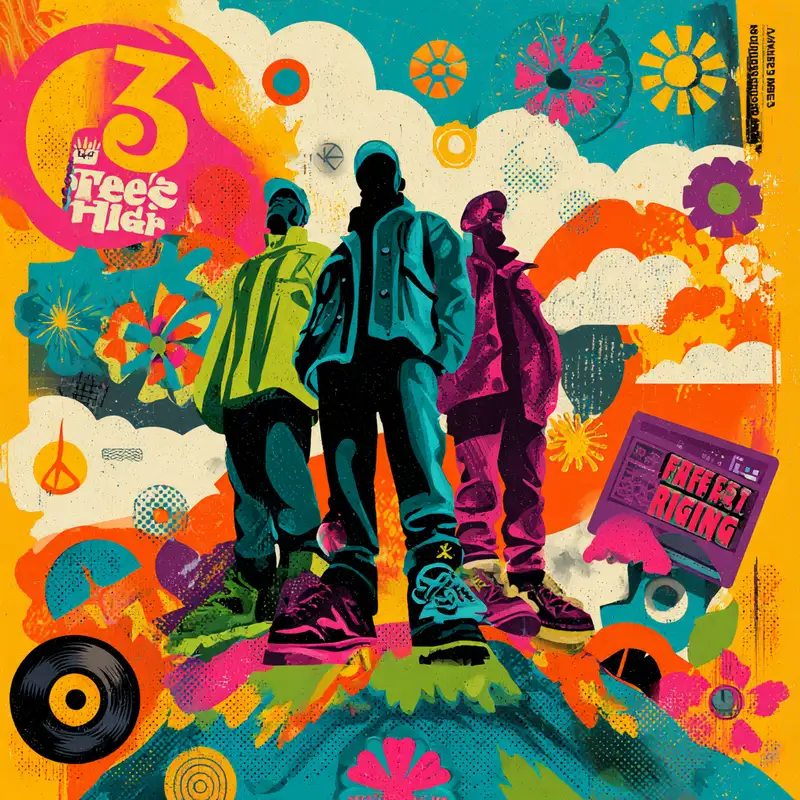
De La Soul's 3 Feet High and Rising: The Album That Changed Hip-Hop Forever (Part 1)
3 Feet High and Rising: The Masterpiece Hip-Hop Can't Hear
The album's influence was immediate and profound. It showed that hip-hop didn't have to conform to the aggressive, streetwise stereotypes that dominated media coverage. De La Soul could rap about self-awareness, surrealism, and social consciousness while maintaining credibility. They could sample French instructional records, Johnny Cash, and Hall & Oates in the same project and make it work.
Critics recognized it instantly. 3 Feet High and Rising appeared on year-end best-of lists, earned Grammy nominations, and established De La Soul as major artists. More importantly, it influenced countless other musicians, helping spawn the Native Tongues collective and encouraging more experimental approaches throughout hip-hop.
The Legal Reckoning
But the album's innovative use of sampling—its greatest artistic strength—became its legal weakness. As hip-hop grew more commercially successful in the early 1990s, rights holders recognized they could profit from sampling. The Turtles' lawsuit over "Transmitting Live from Mars" became a watershed moment, establishing that even brief, transformed samples required clearance and payment.
The financial implications were devastating. An album that had been profitable suddenly carried a massive debt as rights holders demanded retroactive payment. De La Soul found themselves owing money for work they'd already completed, distributed, and been paid for. The legal landscape had shifted beneath them.
Tommy Boy Records, De La Soul's label, responded by restricting the album's availability. Physical copies went out of print. Digital distribution became impossible because clearing samples retroactively was financially unviable. The album that had defined innovative sampling became a casualty of the legal frameworks sampling's success had created.
The Streaming Era's Empty Promise
When streaming services emerged in the 2000s, they promised universal access to music history. Every album, every artist, instantly available for a monthly subscription. But 3 Feet High and Rising remained absent. The sampling issues that prevented physical and digital sales also prevented streaming distribution.
This created a bizarre situation: casual listeners could access obscure albums from every genre and era, but one of hip-hop's most acclaimed and influential releases remained unavailable. The democratization of music access somehow bypassed a landmark recording, creating a hole in the archive that grew more conspicuous as streaming became the dominant way people experienced music.
For younger listeners especially, this absence is particularly disorienting. They've grown up in an era where virtually all recorded music is available on demand. The concept that an important, acclaimed album simply isn't accessible doesn't fit their understanding of how music works. They can hear De La Soul's influences and the artists De La Soul influenced, but not the crucial connecting work.
What Gets Lost
The absence of 3 Feet High and Rising creates multiple problems beyond simple unavailability. First, there's the educational gap. Students studying hip-hop history, sampling techniques, or late-1980s music culture can read about this album's importance but can't experience it firsthand. They're forced to take critics' and historians' word for its quality and innovation.
Second, there's the critical gap. Music criticism depends on shared reference points. When a landmark album becomes inaccessible, those reference points erode. New critics can't verify older critics' assessments. Arguments about the album's place in hip-hop history become theoretical rather than experiential.
Third, there's the creative gap. Artists who might be inspired by 3 Feet High and Rising's approach to sampling, its playfulness, or its sonic adventurousness can't study the original. They're left with secondhand descriptions and the work of artists who were influenced by it—hearing the influence without accessing the source.
Fourth, there's the archival gap. We're losing the ability to understand hip-hop's development accurately. When a crucial piece of the story is missing, the narrative gets distorted. Later innovations seem to emerge from nowhere because the connecting work is unavailable.
The Broader Implications for Sampling
The legal issues surrounding 3 Feet High and Rising didn't just affect this one album—they reshaped sampling culture entirely. After the early 1990s lawsuits, sample-based music became exponentially more expensive and legally complex to produce. Artists faced a choice: either simplify their sampling approach to minimize clearance costs, or risk legal action.
This had profound creative consequences. The playful, densely layered sampling approach that defined 3 Feet High and Rising became financially prohibitive. Albums that might have used dozens of samples now used a handful. The spontaneous, collage-like aesthetic that made early sampling so exciting gave way to more cautious, legally pre-cleared approaches.
Some artists shifted away from sampling entirely, using live instrumentation or synthesizers instead. Others continued sampling but with more conservative choices—using fewer samples, selecting from catalogs with clearer rights situations, or working primarily with material where rights could be negotiated upfront.
The result was a narrowing of hip-hop's sonic palette. Not because artists lacked creativity, but because legal and financial constraints made certain creative approaches untenable. The law didn't just affect what already existed; it shaped what could be created going forward.
The Ownership Trap
De La Soul's struggles with 3 Feet High and Rising are compounded by their lack of ownership. Tommy Boy Records owns the masters, giving De La Soul themselves limited control over their own work. This is a common situation in the music industry, where artists often sign contracts that transfer ownership to labels in exchange for recording budgets and distribution.
For decades, De La Soul fought to regain control of their catalog. They wanted to resolve the sampling issues, make the album available, and ensure they could profit from their own work. But without ownership, they couldn't make unilateral decisions. They needed Tommy Boy's cooperation, and that cooperation was inconsistent.
This ownership structure creates perverse incentives. The party that can make decisions about the album's availability (the label) isn't the party most motivated to solve the problem (the artists). The label faces complex, expensive negotiations to clear samples retroactively, with uncertain financial returns. The artists want their work available and accessible, but lack the legal standing to make it happen.
The situation illustrates a broader problem in music: the disconnect between creative contribution and legal control. The people who made the album don't own it. The entity that owns it didn't create it. And the result is paralysis—work that could be available remains locked away because the parties involved can't align their interests.
The Digital Paradox
We live in an era of unprecedented access to information and culture. Streaming services offer tens of millions of songs. YouTube hosts countless hours of music and music-related content. Digital distribution has made obscure recordings from every era available to anyone with an internet connection.
Yet 3 Feet High and Rising remains largely inaccessible through legal channels. You can find degraded copies on YouTube, uploaded by users who don't own the rights. You can sometimes find used physical copies at inflated prices. But you can't stream it, download it legally, or purchase it new.
This creates a strange situation where the most convenient way to hear a landmark album is through unofficial, legally questionable channels. Fans who want to experience the album as intended have to either break the law, pay collector prices for used copies, or settle for degraded quality.
The paradox reveals how legal structures designed for one technological era fail in another. Copyright law developed primarily around physical media—you controlled access by controlling physical objects. But in a digital era where copying is essentially free and distribution is instantaneous, those old frameworks create bizarre outcomes like this: an album that could be universally available at minimal cost is instead artificially scarce because legal issues prevent legitimate distribution.
What This Means for Hip-Hop History
Hip-hop is now over fifty years old. It has a documented history, recognized classics, and established canonical works. 3 Feet High and Rising is consistently listed among those classics. But unlike other canonical works, this one is substantially unavailable.
This creates problems for understanding hip-hop's development. The late 1980s were a crucial period when the genre was expanding its sonic and thematic range. 3 Feet High and Rising was central to that expansion, proving that hip-hop could be playful, experimental, and psychedelic while remaining authentic.
Without access to the album, that part of hip-hop's story becomes abstract. People can read about it, but they can't experience it. They know it happened, but they can't verify it themselves. The history becomes secondhand, dependent on the testimony of people who heard it when it was available.
As those listeners age and new generations emerge who've never had access to the album, the living memory fades. Eventually, nobody under a certain age will have heard it during its availability. It will exist purely as historical record—something that happened, documented in writing, but not available for direct experience.
This is how cultural memory erodes. Not through deliberate destruction, but through legal and financial neglect. The album still exists physically—copies are in libraries, private collections, archives. But for practical purposes, for the average listener or student, it's effectively gone.
The Question of Resolution
Could this situation be resolved? Technically, yes. Someone with sufficient resources could attempt to clear all the samples retroactively, negotiate agreements with all the rights holders, and make the album available legitimately. But the practical obstacles are immense.
First, there's the cost. Clearing dozens of samples retroactively, especially for a work that's now recognized as historically important, would be expensive. Rights holders know the album is acclaimed and influential, giving them leverage to demand high fees.
Second, there's the complexity. Some samples come from obscure sources where rights are unclear. Some rights holders may no longer exist or may be difficult to locate. The negotiation process could take years and still fail to secure all necessary permissions.
Third, there's the financial uncertainty. Even if someone invested the money to clear everything, would the album generate enough revenue to recoup those costs? The potential market is unclear. Some people who want to hear it have already found unofficial copies. Others may have moved on to newer music.
Fourth, there's the question of who would undertake this effort. De La Soul want their work available but don't own the rights. Tommy Boy owns the rights but faces uncertain returns on the investment needed to clear samples. No third party has obvious incentive to solve the problem.
The result is stalemate. Everyone acknowledges the problem. Nobody has sufficient motivation to solve it. And the album remains in limbo.
The Lesson for Future Creators
The fate of 3 Feet High and Rising sends a clear message to contemporary artists: be very careful with sampling. The creative freedom that made this album possible is now legally and financially dangerous. What seemed innovative in 1989 is prohibitively risky in 2026.
This has reshaped sampling practice. Modern sample-based producers work within much tighter constraints. They clear samples before release, limiting themselves to what they can afford to license. They avoid obscure sources where rights are unclear. They use fewer samples overall, reducing both creative possibilities and legal exposure.
Some artists have abandoned traditional sampling entirely, using interpolation (re-recording similar-sounding parts) or working with sample packs specifically created for legal use. These approaches avoid the legal risks but also lose something of sampling's original spirit—the idea that all recorded sound is potential raw material for new creation.
The situation creates a chilling effect on innovation. Artists see what happened to De La Soul and learn caution. They self-censor, avoiding approaches that might trigger legal problems. The law doesn't just punish past violations; it shapes future creation by making certain creative paths too risky to explore.
Cultural Memory vs. Property Rights
At its core, the 3 Feet High and Rising situation represents a conflict between two values: cultural preservation and property rights. Should important artistic works be preserved and made accessible, even when that conflicts with rights holders' interests? Or should property rights take precedence, even when exercising those rights means culturally significant work becomes unavailable?
Copyright law generally favors property rights. It gives rights holders control over their work, including the right to restrict access or demand payment for use. The theory is that this incentivizes creation—artists can profit from their work because they control it.
But 3 Feet High and Rising reveals the limits of this framework. The people claiming rights to the sampled material didn't create the new work. De La Soul did. Yet the rights holders can effectively suppress that new work by making licensing prohibitively expensive or impossible.
This isn't the outcome copyright law was designed to produce. The constitutional justification for copyright is "to promote the progress of science and useful arts"—to encourage creation by protecting creators' rights. But when that protection prevents new creation or makes important work unavailable, it undermines its own purpose.
The question becomes: at what point does protecting old work prevent new work? When does honoring property rights interfere with cultural progress? How do we balance the legitimate interests of rights holders against the public interest in preserving and accessing important cultural works?
Looking Forward
As we approach 2030 and the album's fortieth anniversary, the situation shows no signs of resolution. The legal issues remain. The ownership structure hasn't changed. The financial incentives still don't align. Nothing suggests this album will become legitimately accessible in the near future.
This means another generation will grow up without access to this landmark recording. Students in 2030 studying late-1980s hip-hop will face the same problem today's students face: reading about an important album they can't hear, trying to understand its influence without experiencing the source.
The situation will likely persist until something changes fundamentally—either in copyright law, in the economics of music distribution, or in the ownership structure of the album itself. Without such changes, we're locked in the current stalemate indefinitely.
Meanwhile, the album continues to age. The people who heard it when it was new are getting older. The cultural context in which it made sense is receding further into history. Eventually, it won't just be unavailable—it will be incomprehensible, a product of a vanished cultural moment that can't be reconstructed.
Why This Matters
3 Feet High and Rising isn't just one album. It's a test case for how we handle artistic innovation that challenges existing legal frameworks. It's a demonstration of how property rights can conflict with cultural preservation. It's a warning about how the law shapes creativity by determining what's too risky to attempt.
The album's suppression represents a failure—not of De La Soul, but of systems that couldn't adapt to new creative practices. Copyright law failed to accommodate sampling as a legitimate artistic technique. The music industry failed to develop licensing structures that could handle densely sampled works. Archival institutions failed to ensure important cultural works remained accessible.
These failures have consequences beyond this one album. They affect how artists work, what gets preserved, how we understand our cultural history, and what becomes possible in the future. Every artist who decides sampling is too risky, every student who can't access important work, every distortion in our understanding of hip-hop's development—these are all costs of the legal approach that made 3 Feet High and Rising unavailable.
We can't change what happened in 1989-1992. But we can recognize that the current situation isn't inevitable. It's the result of choices—legal, financial, institutional—that prioritize certain values over others. Different choices could produce different outcomes. The question is whether anyone with the power to make those choices has sufficient motivation to do so.
As of 2026, the answer appears to be no. And so the album remains in limbo—recognized as important, inaccessible in practice, a silence at the center of hip-hop history. A landmark that nobody can visit. A masterpiece that nobody can hear. The record that keeps spinning, even as the speakers stay silent.
Understanding the Album: A Track-by-Track Journey
To understand why 3 Feet High and Rising matters, you need to hear it. But since that's not possible through legitimate channels, the next best thing is to understand what's there—what De La Soul created, how they did it, and why it sounded like nothing else.
Track 1: "Intro"
The album opens not with a bang but with a skit—a game show called "The Plug Tunin' Last Chance to Comprehend 3 Feet High and Rising Stakes Are High." Right away, De La Soul establishes that this won't be a conventional hip-hop album. There's no aggressive posturing, no street narrative, no claims of dominance. Instead, there's humor, absurdity, and a game show host asking questions.
This choice was radical. In 1989, hip-hop albums typically opened with statements of intent—hard beats, strong voices, clear positioning. De La Soul opened with comedy and confusion, immediately signaling they were playing a different game.
The game show format serves multiple purposes. It's entertaining. It's disorienting. It frames the album as something to be figured out rather than simply consumed. And it introduces the album's central conceit: this is both serious and playful, both sincere and ironic, both hip-hop and something else entirely.
Track 2: "The Magic Number"
"The Magic Number" is built around a sample from "Three Is the Magic Number" by Bob Dorough, from the educational series Schoolhouse Rock! This wasn't a cool source. It wasn't a funk break or a jazz sample or anything with hip-hop credibility. It was a children's educational program.
But De La Soul made it work. They looped the chorus—"Three is the magic number"—and built verses around it. The result is simultaneously childlike and sophisticated, simple and complex. The beat bounces. The rhymes flow. And somehow, sampling Schoolhouse Rock! doesn't undermine their credibility—it establishes a new kind of credibility based on eclecticism and courage.
The lyrics introduce the group's approach: clever wordplay, cultural references, and a refusal to stay in one lane. They reference everything from soul music to psychedelia to everyday life. The rhymes are dense but delivered with casual confidence, as if this level of craft is effortless.
The song became a single and a hit, proving that hip-hop could sample anything and audiences would accept it if the execution was strong enough. It opened doors for future producers to look beyond the traditional crate-digging sources.
Track 3: "Change in Speak"
This brief interlude features a conversation about language and communication. It's not a song—it's a sketch, voices talking about how people communicate differently in different contexts. Again, De La Soul is refusing conventional album structure. They're treating the album as a multimedia experience, not just a collection of songs.
The skit addresses code-switching, how people adjust their language based on context and audience. For a hip-hop album in 1989, this was unusual subject matter. Most rappers presented a single, consistent persona. De La Soul was acknowledging multiplicity, the idea that people contain multitudes and present different versions of themselves in different situations.
Track 4: "The Plug Tunin'"
This is another game show segment, continuing the framing device. The host asks absurd questions. Contestants give absurd answers. The stakes are unclear. The whole thing is delightfully confusing.
What makes this work is commitment. De La Soul doesn't wink at the audience or signal that this is just filler between songs. They treat it seriously, performing it with the same energy as the actual tracks. This elevates the skits from throwaway comedy to integral parts of the album's identity.
Track 5: "Potholes in My Lawn"
"Potholes in My Lawn" samples Funkadelic's "(Not Just) Knee Deep" and The Jarmels' "A Little Bit of Soap." The result is a bouncy, psychedelic track about people who take advantage of success—the hangers-on who appear once you've made it.
The lyrics tell stories of fake friends and opportunists. But instead of angry denunciation, De La Soul delivers the message with humor and frustration. They're annoyed, not aggressive. Disappointed, not violent. This emotional range was unusual in hip-hop at the time, which tended toward more extreme emotional registers.
The production is complex—multiple samples woven together, creating a dense sonic landscape. The beat shifts and morphs. Elements drop in and out. It's not just a loop with rhymes over it; it's constructed, arranged, composed.
Track 6: "Say No Go"
Here De La Soul tackles the anti-drug message required by their label. In the late 1980s, there was significant pressure on hip-hop artists to include anti-drug content, often as a condition of distribution or radio play.
Most groups handled this by including one straightforward anti-drug song that felt disconnected from the rest of their work. De La Soul took a different approach: they made the anti-drug message weird and psychedelic, sampling Hall & Oates and creating a track that sounds nothing like a public service announcement.
The lyrics deliver the message—drugs are bad, don't do them—but with De La Soul's characteristic wordplay and humor. They meet the requirement without compromising their aesthetic. The result is an anti-drug song that actually sounds like part of the album rather than an obligation grafted on.
Track 7: "Do as De La Does"
This track continues the game show format, with questions and answers that make no logical sense. It's absurdist comedy, hip-hop style. The value isn't in the content of the questions or answers but in the commitment to the bit and the sheer strangeness of including this on a hip-hop album.
Track 8: "Plug Tunin' (Last Chance to Comprehend)"
Another game show segment, but now the format is evolving. The questions get stranger. The stakes get higher (somehow). The whole thing is building toward something, though it's never clear what.
This is De La Soul playing with album structure itself. Most albums are front-loaded—best songs first, to hook listeners. De La Soul is doing something different, treating the album as a journey with its own internal logic that rewards listening straight through.
Track 9: "Eye Know"
"Eye Know" samples Steely Dan's "Peg" and Otis Redding's "Dock of the Bay," creating a smooth, jazzy track about being in love. The song is sweet, romantic, and completely uncynical—another departure from hip-hop convention, which typically approached romance with either braggadocio or suspicion.
The lyrics describe a relationship with genuine affection. There's no posturing, no conquest narrative, just appreciation for someone they care about. Pos (Posdnuos) delivers verses about everyday moments—calling on the phone, spending time together, simple connection.
The production is lush and warm. The Steely Dan sample provides a sophisticated harmonic base. The Otis Redding sample adds soul. The result feels both old-school and contemporary, respectful of source material while creating something new.
The song became a single and helped establish De La Soul as more than just experimentalists—they could make accessible, radio-friendly tracks without compromising their artistic vision.
Track 10: "The Plug Tunin' (Make it Plain to Me)"
The game show continues, questions get answered (sort of), and the whole structure becomes more baroque and elaborate. By this point, listeners either find this charming or irritating. There's no middle ground.
Track 11: "Take It Off"
"Take It Off" is De La Soul's commentary on hip-hop itself—specifically, on artists who adopt fake personas. The title refers to removing the mask, being authentic, dropping the act.
The lyrics critique rappers who claim street credibility they don't have, who adopt aggressive personas for commercial appeal, who present manufactured images instead of genuine selves. This was bold in 1989, when much of hip-hop was moving toward harder, more confrontational styles.
De La Soul wasn't attacking those styles per se—they were attacking inauthenticity. If you're hard, be hard. But if you're not, why pretend? The song argues for genuine self-presentation, whatever that might look like for individual artists.
The production samples a range of sources to create a sparse, funky track that gives the lyrics room to breathe. This is De La Soul at their most direct, delivering a clear message with minimal sonic clutter.
Track 12: "A Little Bit of Soap"
Built around The Jarmels' song of the same name, this track addresses cleanliness—both literal and metaphorical. De La Soul raps about staying clean in a dirty world, maintaining integrity in a corrupt industry, and generally keeping yourself together when everything pushes you toward compromise.
The metaphor of soap and cleanliness allows them to address serious topics (industry pressure, artistic integrity, personal ethics) through playful imagery. Again, this is the D.A.I.S.Y. Age approach—serious content delivered through unconventional means.
Track 13: "Tread Water"
"Tread Water" samples Jimi Hendrix's "Ain't No Telling" and creates a psychedelic track about staying afloat, maintaining balance, and navigating difficulty without going under. The water metaphor runs through the lyrics—they're not swimming strong, not sinking, just treading water, keeping their heads above the surface.
This is a surprisingly mature theme for a debut album. Most first albums are about arrival, making it, succeeding. De La Soul is describing the difficulty of sustaining success, the work of staying relevant, the effort required just to maintain position.
The Hendrix sample provides appropriate sonic atmosphere—swirling, psychedelic, slightly disorienting. The production captures the feeling of being in deep water, working to stay afloat, not quite sure where the shore is.
Track 14: "Ghetto Thang"
"Ghetto Thang" addresses De La Soul's relationship with "the streets"—hip-hop's traditional source of authenticity. The song acknowledges that they're not street rappers in the conventional sense, but argues that the ghetto contains multitudes. Not everyone from the hood is hard. Some people are weird, creative, different—and they're no less authentic for it.
The production samples everything from funk to rock to soul, creating a dense, layered track that mirrors the lyrical argument about diversity. The ghetto isn't monolithic, and neither is the music that comes from it.
This song anticipates future debates about hip-hop authenticity. De La Soul is arguing that "real" hip-hop includes artistic experimentation, that street credibility doesn't require conformity to narrow templates, that the culture is big enough for multiple approaches.
Track 15: "Transmitting Live from Mars"
This interlude features voices discussing De La Soul's music, with some people praising it and others criticizing it. The critics claim it's not real hip-hop, that it's too soft, too weird, too different. De La Soul is explicitly addressing the criticism they faced and incorporating it into the album itself.
By including these negative voices, they're acknowledging the controversy while standing firm in their approach. They know they're polarizing. They know purists reject them. And they're okay with that, because they believe what they're doing matters.
Track 16: "Plug Tunin' (Last Chance to Comprehend)"
The game show returns for another round, questions continue, stakes remain unclear. At this point, the format is familiar, almost comforting. It's become part of the album's DNA.
Track 17: "De La Orgee"
"De La Orgee" is a brief, funky interlude that showcases the production skills of Prince Paul. It's not a full song—it's a groove, a vibe, a moment. These kinds of instrumental breaks were common on hip-hop albums of the era, serving as palate cleansers between lyrical tracks.
What makes this work is the production quality. Even on these throwaway moments, Prince Paul brings full attention and craft. The beat is tight, the samples are clean, the mix is balanced. Nothing feels like an afterthought.
Track 18: "Buddy"
"Buddy" features Q-Tip from A Tribe Called Quest and Jungle Brothers, making it a Native Tongues posse cut. The song is about women the artists are interested in—their "buddies." But unlike typical hip-hop songs about women, this is respectful, even sweet. They're interested in connection, not conquest.
The production samples everything from soul to jazz to funk, creating a smooth track that lets each rapper shine. Each verse has distinct personality—De La Soul's playfulness, Q-Tip's smoothness, Jungle Brothers' energy. The chemistry is obvious, and the song helped establish the Native Tongues as a legitimate movement.
The track became a single and a video, and helped introduce audiences to the broader Native Tongues collective. It demonstrated that this wasn't just De La Soul doing weird things—this was a community with shared values and complementary approaches.
Track 19: "Description"
"Description" finds De La Soul describing themselves, their approach, and their place in hip-hop. The lyrics address questions about who they are and what they're trying to do. This is De La Soul's artist statement, delivered in rhyme.
They position themselves as innovators working within tradition. They respect hip-hop's foundations while pushing boundaries. They're not rejecting what came before—they're building on it, expanding it, showing what else is possible.
The production is relatively straightforward, letting the lyrics carry the message. This is intentional—when you're explaining yourself, the words need to be clear.
Track 20: "Me, Myself and I"
"Me, Myself and I" became De La Soul's signature song. Built around samples from Funkadelic's "(Not Just) Knee Deep," the track is about individualism and self-definition in the face of pressure to conform.
The lyrics address multiple pressures: commercial pressure to make radio-friendly music, peer pressure to adopt harder personas, industry pressure to fit marketable categories. Against all this, De La Soul asserts the right to be themselves, whatever that means, regardless of expectations.
The chorus—"Me, myself and I / Is all I got in the end"—became an anthem for anyone who felt like an outsider. It validated being different, being weird, refusing to fit in. For hip-hop listeners who didn't see themselves in gangsta narratives or party anthems, this song was affirmation.
The production is complex and layered. The Funkadelic sample provides the foundation, but Prince Paul adds numerous other elements—vocal samples, sound effects, musical flourishes. The track is dense without being cluttered, complex without being confusing.
"Me, Myself and I" reached #34 on the Billboard Hot 100, proving that alternative hip-hop could achieve commercial success. The song got radio play, MTV rotation, and mainstream recognition. De La Soul showed that weird could sell.
Track 21: "This Is a Recording 4 Living in a Fulltime Era (L.I.F.E.)"
The album's penultimate track addresses life itself—what it means to live authentically in a world full of pressure and compromise. The title references answering machines ("this is a recording"), suggesting that many people live on autopilot, going through motions rather than truly living.
De La Soul advocates for consciousness, awareness, intentionality. Don't just exist—live. Don't just respond to external demands—make active choices. This quasi-philosophical message is delivered through concrete imagery and personal examples, keeping it grounded.
The production is atmospheric and somewhat experimental, with samples creating a dreamlike soundscape. This is De La Soul at their most psychedelic, using production to create mood and meaning beyond the lyrics.
Track 22: "I Can Do Anything (Delacratic)"
The album closes with a statement of possibility. "I Can Do Anything" is exactly what it sounds like—a declaration that De La Soul can do whatever they want, musically and otherwise. They've proven it over the previous 21 tracks. This is the victory lap.
The lyrics celebrate creative freedom. They've made an album that breaks rules, challenges conventions, and succeeds anyway. They've shown that hip-hop can accommodate experimentation. They've expanded the genre's boundaries. And now they're claiming the right to keep exploring, keep innovating, keep pushing.
The production brings back musical elements from earlier tracks, creating a sense of closure. The album comes full circle, ending where it began—with confidence, humor, and a refusal to be limited by expectations.
The final moments fade out gradually, leaving listeners in the space De La Soul created. When it's over, you're not quite sure what happened, but you know you experienced something different. Something that changed what hip-hop could be.
What Made It Work
Looking at the album track by track, patterns emerge. Every choice De La Soul made—the samples, the skits, the topics, the tone—worked together to create a coherent artistic vision. This wasn't randomness. It was carefully constructed experimentation.
The sampling demonstrated that hip-hop producers could pull from anywhere. Not just funk breaks and jazz loops, but Schoolhouse Rock! and Steely Dan and Hall & Oates and Jimi Hendrix. If it worked musically, it was valid source material. This vastly expanded hip-hop's sonic palette.
The skits and game show format made the album an experience rather than just a song collection. You didn't put on one track—you listened to the whole thing, let the flow and structure work on you. This approach influenced how artists thought about album construction for years afterward.
The lyrical content showed that hip-hop could address anything. Romance, authenticity, individualism, friendship, artistic integrity, life philosophy—all valid topics, all worth rapping about. The subject matter didn't have to be streets, parties, or boasting. It could be whatever the artist cared about.
The tone proved that hip-hop didn't require aggression. You could be playful, humorous, ironic, and sincere—sometimes all at once. The emotional range could be as wide as the artists wanted. Vulnerability wasn't weakness. Weirdness wasn't commercial suicide.
All of this added up to a new vision of what hip-hop could be. Not a replacement for existing approaches, but an expansion. The genre was big enough for multiple styles, multiple perspectives, multiple visions. 3 Feet High and Rising proved that by existing and succeeding.
The Sound of 1989
To understand this album's impact, you need to hear it in context—not just hip-hop context, but 1989 musical context generally. This was the year of "Like a Prayer," "Eternal Flame," "Wind Beneath My Wings," and "Another Day in Paradise." Pop music was polished, professional, carefully produced.
Hip-hop in 1989 was splitting into camps. You had party rap like Tone Loc and Young MC. You had political rap like Public Enemy and KRS-One. You had harder street rap emerging with N.W.A. Each camp had its aesthetic, its expectations, its commercial logic.
De La Soul didn't fit any camp. Too weird for party rap. Too playful for political rap. Too soft for street rap. They were uncategorizable, and in 1989, that was commercially dangerous. Radio wanted to know what box you fit in. Retailers wanted to know what section to stock you in. Audiences wanted to know what they were getting.
But Prince Paul's production gave the album undeniable musicality. Whatever you thought of the concept or the lyrics, you couldn't deny the beats. The samples were clever. The arrangements were tight. The mixing was professional. This sounded like a real album, not an experiment.
And De La Soul's performances matched the production quality. The rhymes were sharp. The delivery was confident. The chemistry between the three MCs was obvious. This wasn't amateur hour—these were skilled artists executing a clear vision.
That combination—musical quality plus unconventional content—made the album impossible to ignore. Critics had to take it seriously. Radio had to give it a chance. Audiences had to form opinions. It forced engagement.