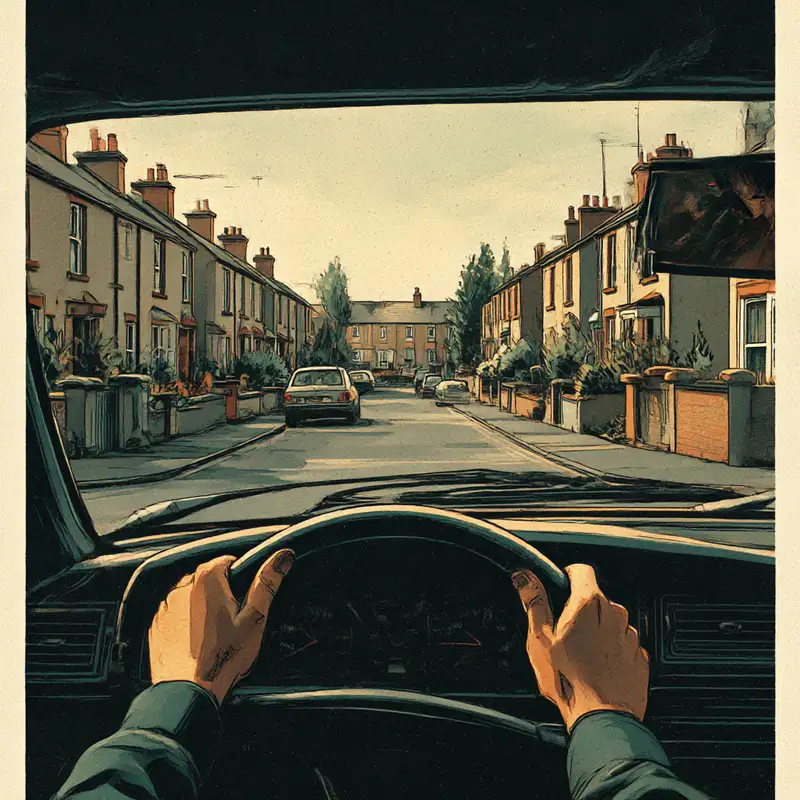
Better World with Design: The First Driving Lesson (8 of 15)
The First Driving Lesson
Welcome to Better World with Design—a personal playground where I explore the things that shape how we see, think, and live. This podcast is my space to review books, music, design, and culture, and to add whatever content moves me in the moment.
But it's also something more: a home for stories I've been carrying for years. Over the coming weeks, I'll be sharing a series of short stories, each one inspired by journal entries I kept during my early years in Northern Ireland. These are fictional narratives—characters, locations, and events have been changed, and the perspective reimagined—but they're rooted in the emotional truth of those recorded moments, transformed into stories that I hope resonate beyond their origins.
In our first story, we stood at a shop window on Sandy Row, watching a bowler hat that became something more—a £15 purchase that turned into a small, stubborn act of wearing history while trying to write a different future. In our second, we stepped into a shoe shop on Royal Avenue, where a rugby player and a shop assistant found brief connection in the careful ritual of fitting shoes. In our third, we visited a church disco in Bangor, where two young men performed righteousness while navigating the careful theater of faith.
Today's story takes us somewhere quieter, more intimate. It's about a first driving lesson on a Belfast driveway, about learning to navigate forward motion while constantly checking what's behind you. It's about Tessa's silence and Orla's tiny jumpers and the way we shuffle rooms to mark time passing. It's about missionaries and De La Soul tapes and the particular weight of growing up Mormon in a city that already had too many lines drawn.
This is "The First Driving Lesson"—a story about clutch and accelerator, mirror and signal, and the hundred yards that become the beginning of everything.
The First Driving Lesson
I couldn’t get out of bed. The morning had a particular quality of resistance, as if the sheets themselves were conspiring to keep me from the day ahead, but I still made it on time for school. That was the thing about those days—no matter how the morning fought against you, you still showed up, still performed the rituals of teenage life in Belfast.
I called over at the missionaries’ flat to give them my testimony book to write in. The flat was above the chippy on High Street, always smelling of yesterday’s grease and today’s laundry. Elder Nolan was there, sorting through Books of Mormon like they were football cards. I picked up Maeve’s Book of Mormon for him to write in. These small errands, these exchanges of holy texts between teenagers who barely understood what they’d gotten themselves into—this was how we measured our days.
School was fine today, for I got 61% on my RE test. Which, for me, felt like a win. A Mormon, I’d gotten above average marks in Religious Education at a state school—a detail I found quietly absurd. Mrs. Doyle, who taught the class, had asked me questions about the church, about the missionaries she’d seen going round the houses. She said the Mormon missionaries were so nice looking that she’d seen them going round the houses, but they hadn’t called at hers. She spoke wistfully, as if she had missed out on something she wasn’t sure she wanted.
Got home just before one. Mum was here. The house had a particular stillness it only got when Dad was at work and Orla had moved out. Mum’s car was in the drive—the red Ford Escort that had been the family car since I was twelve. And she took me on my first driving lesson.
At first, we didn’t plan to go anywhere—just to get used to where everything was. We sat in the car in our own driveway, Mum patient in the passenger seat, me gripping the steering wheel like it might try to escape. The plastic was cold in my hands. Everything about the car seemed designed for someone else—someone taller, someone older, someone who knew instinctively which pedal did what.
“That’s the clutch,” Mum said, pointing to the left pedal. “You’ll need to press that every time you change gear.”
The gear stick jutted up between the seats, mysterious as a divining rod. The whole dashboard was a language I hadn’t learned—dials and lights and symbols that meant something to people who knew what they were doing.
“The mirror,” Mum said, adjusting the rearview. “You need to see what’s behind you.”
I looked at my reflection in the mirror—my face pale and uncertain, framed by the back windscreen and the familiar street beyond. This was the view from the driver’s seat: forward and backward simultaneously, always checking what you’re leaving behind while trying to navigate what’s ahead.
The church members printed and memorized the route, including lessons, testimonies, home visits, and doctrine. Outside the windscreen, the road buckled with human potholes Tessa wouldn’t name, Orla’s baby arriving ahead of its map, and Finn turning out to be someone no one had diagrammed.
We were going to drive up the road. The plan was simple: just to the end of our street and back. A hundred yards of tarmac that I’d walked a thousand times, now transformed into a test of coordination and nerve.
Just as I was about to pull off, Tessa and Phoebe called.
Their timing was impeccable. I had my foot on the clutch, Mum had just told me to turn the key, and there they were—Tessa’s blonde head visible through the windscreen, Phoebe beside her. It was nice seeing Tessa again. She’d been in Belfast, some complication with meeting Phoebe, and we hadn’t properly talked in weeks.
Even though we talked little. We were both trying not to go into anything deep. This was how it had been since the phone call, since whatever had happened that she wouldn’t talk about. The thing with Tessa was that you could see the weight of what she wasn’t saying. It sat on her shoulders, made her movements careful, her smile too bright.
“You learning to drive then?” Phoebe asked, leaning against Mum’s window.
“First lesson,” I said.
“Don’t crash,” Tessa said, and laughed, but it wasn’t her genuine laugh. It was a performance of someone who used to find things funny.
At three, Phoebe and Tessa went home. Phoebe is now staying with Tessa. Phoebe is a new girl. This detail felt significant somehow—Phoebe staying with Tessa, the two of them navigating whatever complicated friendship they’d constructed. In Belfast, people didn’t just visit; they stayed, they moved in; they created temporary families to replace or supplement the permanent ones that didn’t quite work.
After they left, Mum and I returned to the car. Now we could begin the lesson that was interrupted properly.
“Right,” Mum said. “Turn the key.”
The engine caught, louder than I’d expected. The car vibrated beneath us, alive and waiting.
“Clutch down. First gear. Check your mirror. Indicate.”
Each instruction was simple. Together they formed an overwhelming sequence of actions that had to happen simultaneously, in the right order, with the right pressure and timing.
“Now, slowly—slowly—lift the clutch while you press the accelerator.”
The car lurched forward like a startled animal. I slammed my foot back on the clutch, and we jerked to a stop.
“That’s alright,” Mum said. Her voice had a forced calm that parents use when they’re trying not to sound afraid. “Try again.”
The second attempt was smoother. The car crept forward, and suddenly I was driving. Actually driving. The street moved past us at walking pace, but it felt like flying. Everything looked different from behind the wheel—the familiar houses strange, the road wider than it seemed on foot, the entire world rearranged around this simple act of forward motion.
“That’s good,” Mum said. “Keep it steady.”
We reached the end of the street. A T-junction with the main road, cars flashed past with casual competence.
“We’ll turn around here,” Mum said. “Just pull in.”
I parked without hitting the curb, though it took three attempts to get the angle right. The car stalled twice. Each time, Mum said, “That’s alright” in the same carefully neutral voice.
Turning meant a three‑point turn. Mum counted it out—full lock right, reverse, full lock left. The car crabbed, and I blanked for a second on which way to steer in reverse, then it clicked and we were facing home.
The drive back stretched. My hands, the pedals, the minor corrections—every tiny movement had weight. This was a responsibility: machine, speed, and the knowledge of how quickly it can all go wrong.
I parked on the driveway. The handbrake made a satisfying ratcheting sound.
“There you are,” Mum said, the tension leaving her voice.
I got a letter from Elder Shaw, which I didn’t think I would be getting. It was waiting inside, forwarded from Dungannon. I had assumed that was the end of it because Elder Shaw had transferred weeks before; he was another missionary who had passed through our lives and moved on. But here was his handwriting on an envelope, proof that I’d registered in someone’s memory enough to warrant a letter.
I didn’t take a seat on it. I made the tea, cleared the table, and wrote him back then and there: dates, triumphs, and awkward bits. The postbox swallowed my words, and I walked the envelope there.
I flipped the envelope over, thumb on the damp seal, and set it beside the kettle. I’d have to give him a full account. What to tell him? The first driving lesson. Tessa’s silence. The feeling of being lost in Orla’s old room. I was learning to navigate not just roads, but the complicated terrain of growing up Mormon in Belfast.
On paper, that terrain was orderly—structured Sundays, a rota of callings, missionaries who knocked and moved on. But my days kept refusing the outline: Tessa’s silence widening like a no-go zone, Orla knitting futures the size of a forearm, and Finn’s hidden, laughing self slipping past the labels people had stamped on him.
I have now moved into Orla’s old bedroom. It’s a lot bigger than my old one. And it shall take some getting used to. For I feel lost within it. The room was twice the size of my old one, with windows that looked out over the back garden. Orla’s presence lingered in ways I couldn’t quite name—in the wallpaper's pattern, in the way the floorboards creaked in certain spots, in the space's shape itself.
It didn’t look too bad, aside from the wallpaper. The wallpaper was a relic from the seventies—brown flowers on a cream background, the pattern that had seemed elegant once and now just looked tired. Dad was already colonizing my old room with his tools—everything in labeled drawers, socket sets nested like a testimony meeting in rows—while the rest of the house made space for outcomes no handbook covered. This shuffling of rooms, this redistribution of space—it was how families marked time, how they acknowledged children grew up and moved on, even if they hadn’t actually left.
That night I lifted his socket set off the windowsill and cleared a corner for myself—desk against the radiator, exercise books stacked, pens in a mug. Not a rebellion, just a small perimeter set and held.
Finn and the girlfriend called down. Finn was bringing me the De La Soul tape down. Which was nice of him. Finn was that kind of person—reliable in small ways, always following through on casual promises. Then again, Finn is a really nice person. Am starting to really like him. He’s not the type of person everyone thinks he is, for inside there’s a fun, funny type of person, whereas most people think he's a shy type of person.
The case was clear plastic with a crooked hinge, his track list in blue biro. When we played it later, there was a soft tape hiss and a bass that made the cheap speakers breathe.
In Belfast, the revelation came slowly: people weren’t what they seemed at first glance. That the quiet ones had whole worlds inside them, that the performers were often the loneliest, that everyone was navigating their own complicated geography between who they were and who they appeared to be.
I phoned the Elders in Dungannon to check about Finn and me going up to stay. They said, hey come on. So, we are going up on the first weekend of the month. These visits to other branches, these temporary escapes from our own congregation—they were how we built a larger sense of community, how we convinced ourselves we were part of something bigger than just the handful of Mormons in our own town.
I didn’t wait for it to arrange itself. After I rang Ulster bus, I copied the Saturday timetable into my diary and set aside the fare notes. I wrote a line to Mum—“gone early Sat, back after evening meeting”—and set Finn’s tape by the door so I wouldn’t forget it.
I hoped the new missionaries would know Niamh from Cork, since he had just moved from Cork. He doesn’t, so much for that. The church was small enough that you always hoped for these connections, these links between different missions and different cities. When they didn’t materialize, it reinforced how fragmented everything was—islands within islands, small clusters of believers scattered across Ireland with no genuine connection except doctrine.
Mum had made a lot of jumpers for Orla’s baby. They look tiny. The tiny garments hung over the backs of chairs, evidence of a future that was rushing toward us whether we were ready. Orla was having a baby. Orla, who’d lived in this room I now occupied, who’d walked these same streets and probably had her own first driving lesson in Mum’s patient company. Time moved in circles and lines simultaneously—repeating patterns with everyone shifted one position forward.
The ward calendar told you what to bring to the potluck; it said nothing about how small a future looks when it’s hung to dry.
I didn’t read my Book of Mormon until the last thing at night. I shall have to break the habit am getting into. The book lay on the nightstand, its blue cover familiar as my face. Reading the last thing at night meant reading half-asleep, the verses washing over me without sticking. But reading first thing in the morning meant confronting the day with scripture fresh in my mind, meant starting each day with that Mormon discipline of study and contemplation.
I was talking to Mrs. Doyle today for the first time in ages. Oh, hey! She’d said, seeing me in the corridor after class. Those missionaries never called at my house. There was something plaintive in her voice, something that suggested she’d been waiting, that she’d have answered the door if they’d knocked.
Tessa left me a letter in which she faces up to the fact that something is wrong. And that she is making a mess. She also said that she didn’t want to talk about it yet. For she said she wanted to come to terms with it before she started talking to anyone. I wish she would just talk to me about whatever it is.
I let the quiet be hers and kept a seat for when she was ready.
This was the hardest part—watching someone you cared about struggle and being shut out from helping. Tessa’s silence was its own kind of statement, her refusal to share a way of maintaining control over something that was clearly spinning beyond her grasp. And I had to respect it, had to wait, had to hope that eventually she’d trust me enough to let me in.
Saw Ruby today for a while. I had a class to go to, so I never got to talk to her much. These partial conversations, these interrupted connections—they were the texture of teenage life. Everyone moving in different directions, touching briefly before being pulled away by schedules and obligations.
The day ended the way it began—in the same house, the same room, but somehow everything was different. I’d driven a car. I’d moved forward under my power, navigated a path, made decisions that translated into actual movement through space. It was a small thing, trivial even. A hundred yards up a residential street and back.
But it was also enormous. It was the first step toward independence, toward being able to leave when I wanted to leave, to go where I wanted to go. It was the beginning of a geography that would be mine to choose rather than one determined by bus routes and parents’ schedules and the limited radius of walking distance.
In the mirror of Mum’s car, I’d seen my face looking back—uncertain, nervous, trying. Behind me, the street I’d grown up on. Ahead, through the windscreen, were roads that would take me to Portadown, to Belfast, to Dungannon, to all the multiple towns that made up the fragmented landscape of Northern Irish Mormon life.
The lesson was simple: clutch, gear, accelerator, brake. Mirror, signal, manoeuvre. Mechanics.
The truth wasn’t. Driving was leaving. It was proof you could move under your own power, not fixed by bus routes or other people’s plans. The freedom would take years to claim, but it started here, in the driveway, with Mum’s patient voice and my uncertain hands.
Maybe that’s the point: the Church gave lanes, mirrors, signals—ways not to drift. Life stalled and surged—Tessa holding the bite point too long, Orla already rolling, Finn taking an unexpected side street. Between handbook and happenstance, I learned to feather the pedals.
Doctrine drew the map. We still had to learn the corners.
I lay in Orla’s old room, bigger now, lost but with space to grow. Tomorrow there would be more lessons—in driving, in faith, in friendship.
Tonight I’d moved forward. A hundred yards under my power.
It was enough. A beginning.
That's the end of the story. If you want to hang on a few more minutes, I'll share some of the background about it.
That first driving lesson was more than learning to operate a vehicle—it was a threshold moment, one of those ordinary experiences that carries extraordinary weight when you're young. In retrospect, it marked the beginning of a long journey toward independence, toward claiming the ability to navigate not just roads, but life itself.
The metaphor isn't subtle, but it's accurate: learning to drive in that driveway, with my mother's patient instructions and my own uncertain hands, was practice for everything that would come after. The Church provided the framework, the lanes and mirrors and signals—the doctrine that was supposed to keep us from drifting. But we still had to learn the corners ourselves, still had to figure out how to feather the pedals between what we were taught and what we actually encountered.
Thank you for listening to this first story from my Northern Ireland journals. In the coming episodes, we'll explore more of these moments—the small revelations and quiet transformations that shaped those years. Each story stands alone, but together they map a particular geography: the landscape of growing up Mormon in Belfast, of navigating between doctrine and experience, between who we were told to be and who we were becoming.
If you enjoyed this episode, please subscribe and share it with others who might appreciate these reflections on faith, family, and finding your way in complicated terrain.
Until next time, this is Better World with Design.